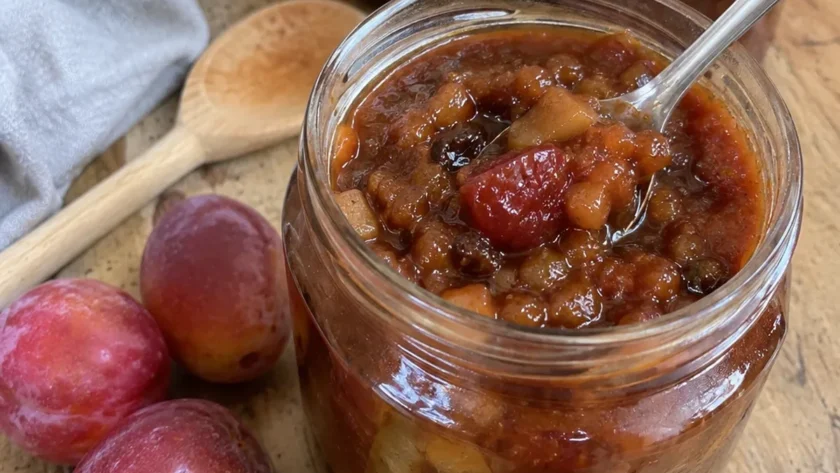

Delia Smith dower house chutney is a very old recipe, first written by hand on a yellowing page in someone’s great-grandmother’s cookbook. You cook Victoria plums, cooking apples, tomatoes, onions, raisins and preserved ginger very slowly in malt vinegar, with chillies in a gauze bag. It fills eight jars, so allow about 2½ hours for the chopping and slow cooking.
Her 1992 Complete Cookery Course prints it on page 609, where she calls it an extremely good recipe. The older 1983 printing spells it Old Doverhouse chutney and weighs the apples after peeling, while 1992 weighs them after coring and quartering. Both names lead to the same jar.
Its plums, apples and raisins make it a close cousin of her spiced plum chutney, which also works with damsons. If you want something quick with no cooking at all, try her fresh spiced apple chutney instead.
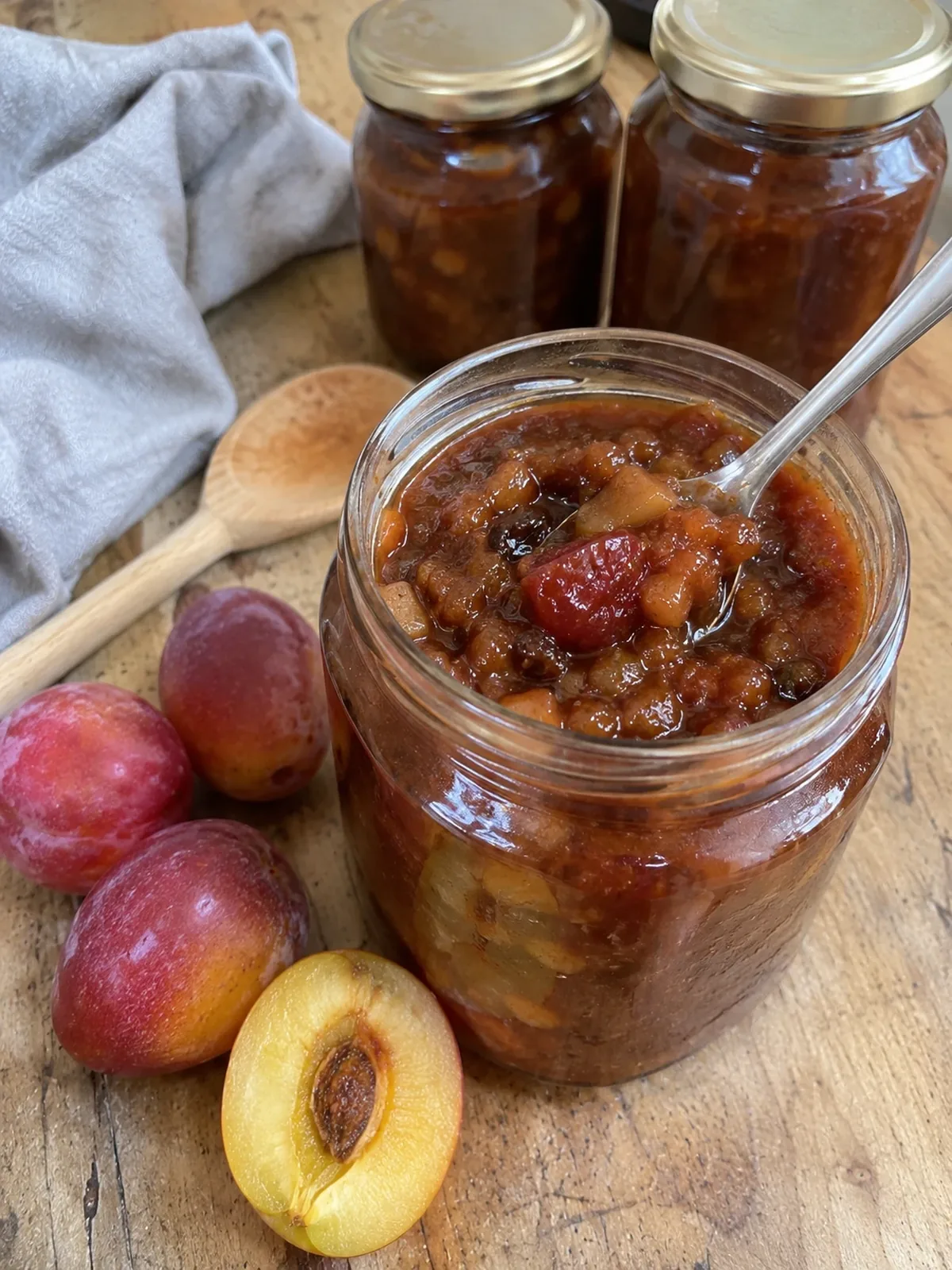
Delia Dowerhouse Chutney
Victoria plums, apples and tomatoes cooked down slowly with raisins, preserved ginger, garlic and chillies in malt vinegar and demerara sugar.
8 jars
servings45
minutes1
hour40
minutes30
kcalIngredients
- For the chutney:
700g plums, preferably Victorias
225g green or red tomatoes, whatever’s available
225g onions
700g cooking apples, weighed after coring and quartering (about 900g to start with)
450g stoned raisins
110g preserved ginger (the sort preserved in syrup)
5g garlic, finely chopped
570ml malt vinegar
700g demerara sugar
1½ tablespoons cooking salt
5g whole dried chilli peppers
Directions
- Plums: Pick over and wash the plums, cut them in half and remove the stones. Cut the halves in two, or in three if very large.
- Tomatoes: Chop the tomatoes roughly into not-too-small pieces and put them in a preserving pan with the plums.
- Mince: Pass the onions, apples, raisins and preserved ginger through the coarse blade of a mincer, or chop them finely in a food processor.
- Pan: Add them to the pan with the garlic, vinegar, sugar and salt.
- Chillies: Tie the chillies in a small square of gauze with string and hang them from the pan handle.
- Cook: Cook the chutney very slowly for about 1 to 1½ hours, until most of the liquid has evaporated. Give it a few good stirs, especially towards the end.
- Test: Draw a wooden spoon across the surface. If the channel stays for a few seconds without filling with vinegar, it is ready.
- Pot: Pot the chutney while it is still hot into hot jars. Seal with waxed discs and tight lids, and label when cold.
FAQs
Is it Dowerhouse or Doverhouse?
Both spellings are right, because Old Dowerhouse and Old Doverhouse are the same chutney in two printings of her Complete Cookery Course. The 1983 edition printed Doverhouse and admitted she had no idea where the name came from. By 1992 it had become Dowerhouse, after several readers corrected her.
Which plums should I use?
Use Victoria plums if you can, since the recipe says preferably Victorias, and that makes it a true Victoria plum chutney. Wash them, halve them and take out the stones, then slice every half into two pieces, or three for big ones.
Green or red tomatoes?
Either colour works, as the recipe says whatever’s available, so it is a good home for the last tomatoes of the season. Cut them into fairly large chunks rather than fine dice.
What is preserved ginger?
It is ginger sold preserved in syrup, and the recipe asks for 110g of it. It goes through the mincer or processor with the onions, apples and raisins, so it ends up in small, sweet, spicy pieces.
Why is my chutney taking so long?
A reader on her website found it took 5 hours, not an hour and a half at most. The answer there was mostly about the pan. Use a wide, heavy stainless steel preserving pan, because the wider the surface, the faster the liquid evaporates.
A smear of butter over the base helps stop it catching. Bring it to simmering point over a medium-high heat on your largest ring. Then turn it down so a bubble rises every few seconds, and stir more often as it thickens.
How do I know it is ready?
Use the channel test from her chutney notes on page 606. A line drawn with a wooden spoon should stay open briefly with no vinegar seeping back, and most of the liquid should have gone.
How long should it mature?
Leave the chutney for at least three months, because freshly made chutney is too harsh and vinegary. That is her rule for all chutneys in the Complete Cookery Course. Keep the jars somewhere cool and dark, such as under the bed in the spare bedroom or a covered cardboard box in the garage.