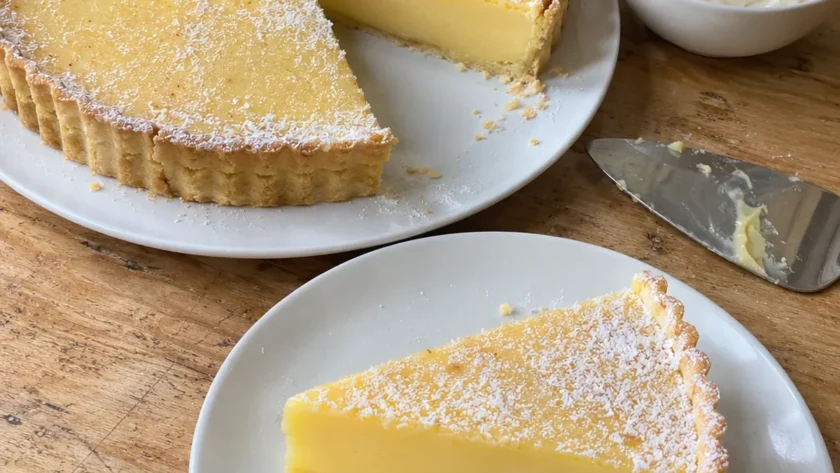

You bake Delia Smith lemon tart in a deep tin, so every slice is a thick layer of sharp, creamy lemon on very thin pastry. It feeds 6 to 8, and you can serve it warm or cold from the fridge. Give yourself about 1 hour 40 minutes, though 30 of those are just the pastry resting.
She settled on this one as her definitive version, after trying every kind of lemon tart going. The same amounts appear in the Winter Collection (1995), the Vegetarian Collection (2002) and, in 2006, The Delia Collection: Puddings.
Her website now calls it Thick Lemon Tart and makes a smaller one in a 20cm tin, and the FAQs give that smaller tart too. It is a baked lemon custard, so there is no cornflour and no meringue on top.
If you want it warm, let it cool for about 30 minutes, though she says it is extremely good chilled too. Whole or in slices, it keeps in the freezer for 3 months, her website says, and thaws overnight in the fridge.
For a lemon pudding with no pastry and no oven, try a lemon posset recipe set in glasses, or her no-bake lemon cheesecake.
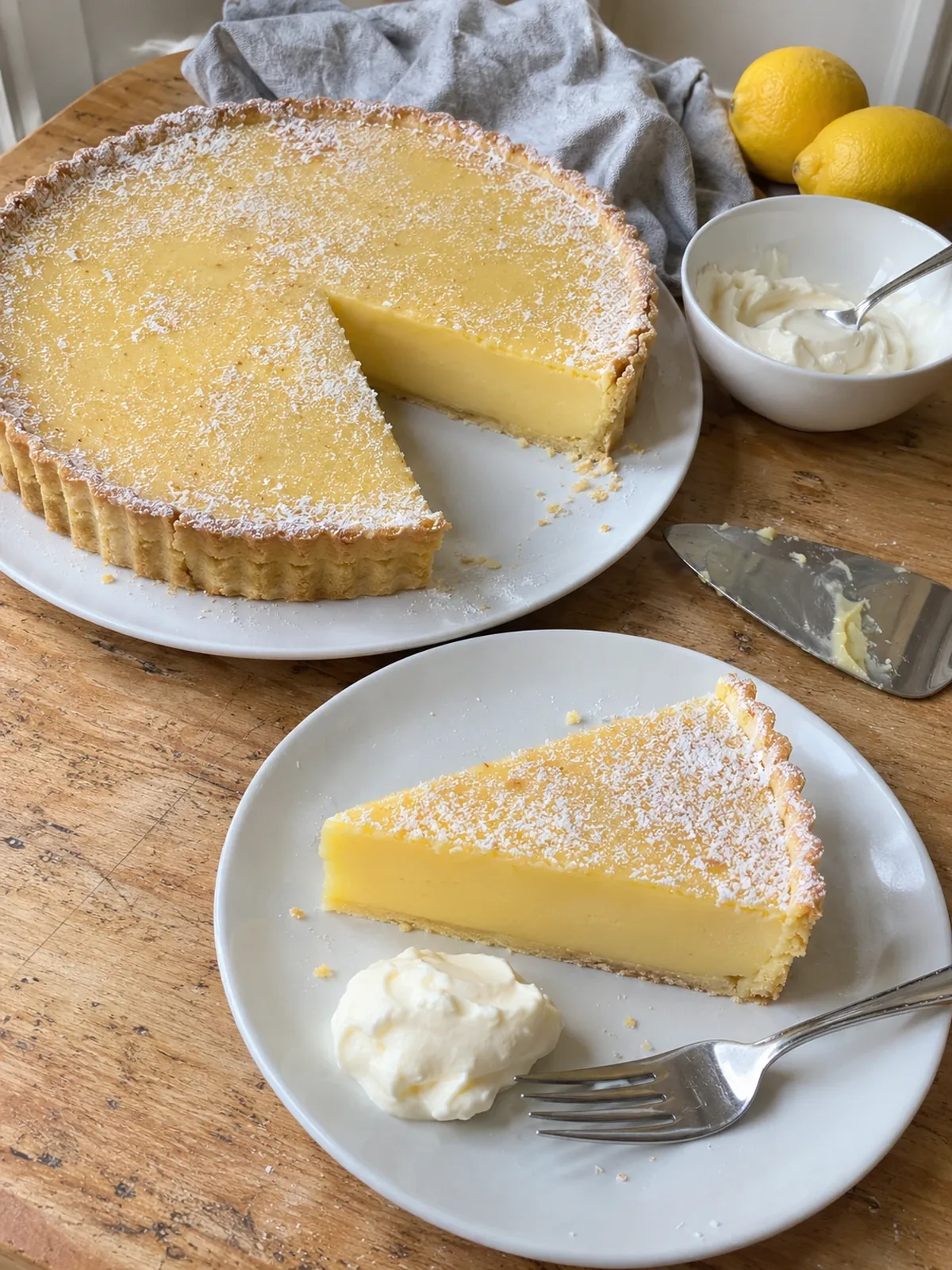
Delia Smith Lemon Tart Recipe
Her Deep Lemon Tart: a thick lemon filling baked in a crisp sweet pastry case, served warm or chilled.
8
servings20
minutes50
minutes420
kcalIngredients
- For the pastry:
175g plain flour
40g icing sugar
75g softened butter
a pinch of salt
1 large egg, separated
1 tablespoon water
- For the filling:
6-8 lemons
6 large eggs
175g golden caster sugar
200ml whipping cream
- To serve:
a little icing sugar
crème fraîche
Directions
- Pastry: Put the flour, icing sugar, butter, salt, egg yolk and water in a food processor, keeping the egg white aside. Process until it forms a firm dough.
- Rest: Knead it lightly, seal it in a polythene bag and chill for 30 minutes.
- Oven: Heat the oven to 200°C, gas mark 6, with a solid baking sheet inside. Lightly oil a deep, loose-based fluted tart tin, 23cm across and 4cm deep.
- Line: Roll the pastry out as thinly as you can and line the tin, pressing it up the sides to stand about 5mm above the rim.
- Seal: Prick the base with a fork, then brush it all over with the lightly beaten egg white.
- Bake: Bake the case on the hot baking sheet on the middle shelf for 20 minutes. As it comes out, turn the oven down to 180°C, gas mark 4.
- Filling: Grate the zest of 6 lemons and squeeze enough juice to make 275ml. Whisk the eggs and sugar just to combine, then whisk in the juice, zest and cream lightly.
- Fill: Pour the filling into a 1.2 litre jug. Put the case back on the baking sheet in the oven and pour the filling straight in.
- Finish: Bake for about 30 minutes, until the tart is set and feels springy in the centre.
- Serve: Cool it for about 30 minutes to eat warm, or chill it. Dust with icing sugar just before serving, with well-chilled crème fraîche.
Notes
- You may need all 8 lemons to get 275ml of juice.
- The Winter Collection (1995) lists size 1 eggs and plain caster sugar.
FAQs
How do I make it in a 20cm tin?
For a 20cm tin, use her website’s smaller version, which keeps the same pastry in a loose-based tin 4.5cm deep. The filling uses 5 lemons for 225ml of juice, 5 large eggs, 150g of the same sugar and 175ml of double cream.
That case is frozen for 30 minutes, lined with foil and given a 15-minute bake at 190°C. Then the foil comes off, and the case gets a brush of beaten egg from the filling. After 7 or 8 minutes more, the filled tart needs about 30 minutes at 180°C.
How do I keep the pastry crisp?
The pastry stays crisp because the base is pricked with a fork and brushed with egg white before it bakes, which seals it. The hot baking sheet underneath helps too, since it sends heat straight into the base. Keep the pastry thin when you roll it, so the filling is the star.
How do I know when it’s set?
The tart is ready after about 30 minutes, once the filling springs back lightly when you touch the middle. A slight wobble in the very centre is fine, because it firms up as it cools.
If yours takes longer, your eggs may be on the small side. Her website allows 65g of beaten egg for each large egg, so 6 large eggs come to about 390g.
Why did my lemon tart crack?
A lemon tart usually cracks when it bakes too long or too hot, so the egg filling sets hard and shrinks as it cools. Check it at 25 minutes and take it out while the very centre still trembles a little.
Whisking the eggs and sugar only until combined helps as well, because she warns that overdoing it thickens the eggs. Any small cracks disappear under the dusting of icing sugar.
Is there a cheat version?
Yes, a ready-baked 195g all-butter sweet pastry case and a 312g jar of lemon curd make the cheat version in her 2008 How to Cheat at Cooking. You mix the curd with the zest and juice of 1 large lemon, 1 beaten egg and 2 tablespoons of half-fat crème fraîche.
It sets in a 170°C oven in 20 to 25 minutes, then chills for 1½ hours, and it serves 6. The same page tops it with meringue for a cheat lemon meringue pie.
Is there a Bakewell-style lemon tart?
Yes, her Lancaster Lemon Tart is a Bakewell-style tart, with an almond sponge baked over a layer of lemon curd. The Complete Cookery Course (1992) uses 3 rounded tablespoons of it on the pastry, and lemon rind and juice go into the sponge.
It is smaller, for 4 to 6, and bakes on an 18 or 20cm pie plate. It starts at 200°C for 15 minutes before the oven drops to 150°C for a further 25 to 30.