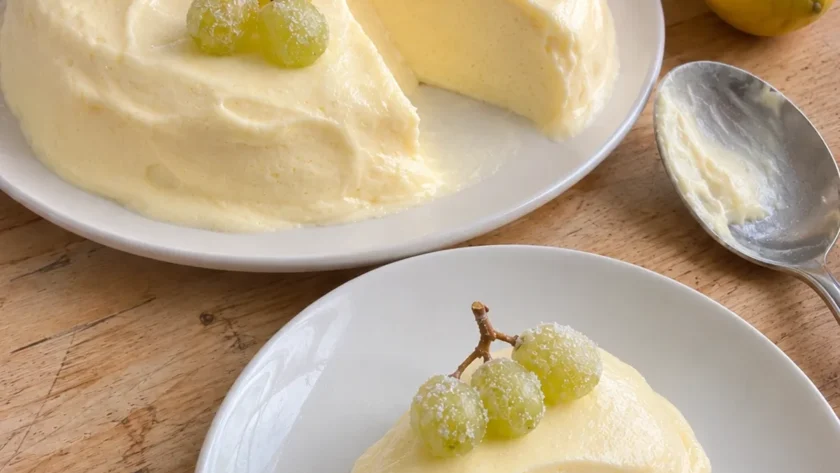

Delia Smith’s lemon mousse is her Rich Lemon Cream with Frosted Grapes, a cold party pudding for 12 people. You set lemon, double cream and whisked egg whites with gelatine in a round tin, then turn it out and cut it into slices. The only cooking is 3 or 4 minutes of gentle heat, so allow about 30 minutes of work and at least 3 hours to set.
She rates it above every other lemon dessert she has come across. It is a mousse in all but name, because gelatine, whisked whites and whipped cream give it that airy texture. The 1983 Complete Cookery Course prints it, and the 1992 revision adds 25ml more cream. It is in the Complete Illustrated Cookery Course (1989) too.
It is a different pudding from her lemon surprise, a hot baked lemon pudding that hides a sauce under its sponge. This one is served cold and cut in slices, with sugar-frosted white grapes on top, while her deep lemon tart bakes its filling in pastry.
The egg whites are not cooked, so keep the mousse covered in the fridge until you serve it. Her no-bake lemon cheesecake with frosted grapes uses the same sugar-dipped fruit, and her dark chocolate mousse is the one for chocolate lovers.
Delia Smith Lemon Mousse Recipe
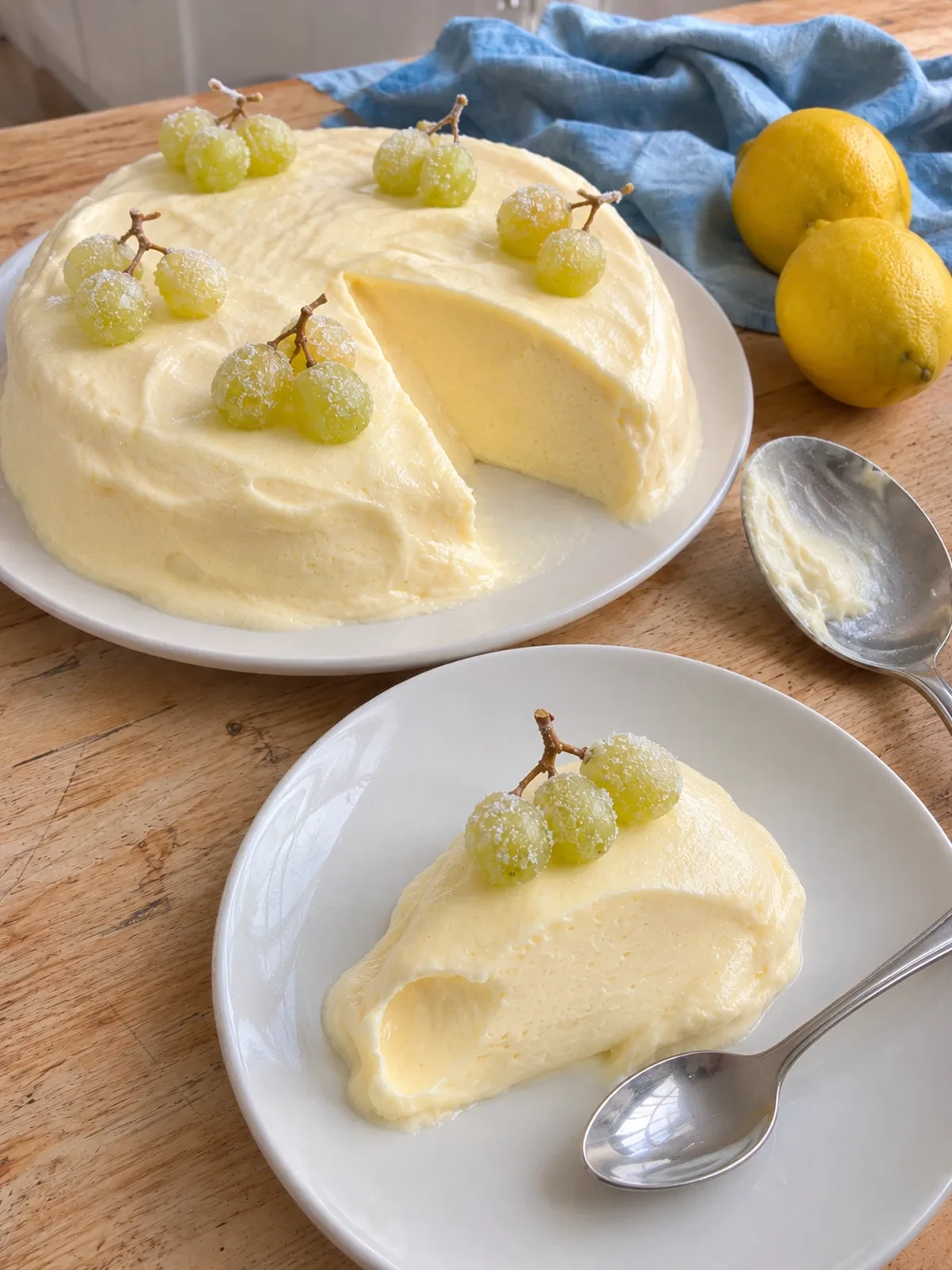
Her party lemon cream for 12: a light mousse set in a round tin, turned out onto a plate and cut like a cake.
12
servings30
minutes4
minutes340
kcalIngredients
- For the lemon mousse:
150ml milk
4 level tablespoons caster sugar
4 lemons
1 level tablespoon powdered gelatine
1 egg yolk
725ml double cream
4 large egg whites
- For the frosted grapes:
110g white grapes
1 egg white
caster sugar, for dipping
Directions
- Tin: Lightly oil a 20cm round cake tin. Grate the rind of the lemons and squeeze out the juice.
- Blend: Put the milk, sugar, lemon rind, gelatine and egg yolk in a blender or liquidiser and blend at top speed for 30 seconds.
- Heat: Pour into a small pan and stir over a very gentle heat for 3 or 4 minutes, until fairly hot but never boiling.
- Lemon: Return it to the blender with the lemon juice and 275ml of the cream, and whizz until well blended.
- Chill: Pour into a bowl, cover with foil and chill, stirring from time to time, until it turns syrupy.
- Whisk: Whip the remaining 450ml of cream lightly, just until it begins to thicken. In a very large bowl, whisk the 4 egg whites until stiff.
- Fold: Carefully fold the egg whites into the lemon mixture, then fold in the whipped cream.
- Set: Pour into the tin, cover and chill until firm.
- Grapes: Whisk the single egg white and break the grapes into clusters of 2 or 3. Dip each cluster in the white, then in caster sugar, and leave on greaseproof paper for a couple of hours.
- Serve: Dip the tin into hot water for a moment and turn the mousse out onto a plate. Arrange the grapes on top and slice it like a cake.
Notes
- The book gives no setting time, only "until firm", so allow at least 3 hours or make it the night before.
- Make the frosted grapes at least 2 hours ahead so their sugar coating can dry.
FAQs
How do I make a smaller lemon mousse?
A smaller lemon mousse for about 6 people sets in a 15cm tin, using the half-size quantities the book gives. Keep 1 egg yolk, use 1 level dessertspoon of gelatine, then halve the rest: 75ml milk, 2 level tablespoons of sugar and 2 lemons.
You then need about 360ml of double cream and 2 egg whites, plus half the grapes. For an even smaller batch with no gelatine, a lemon posset sets in glasses with just cream, sugar and lemon.
How syrupy should the lemon mixture be?
The lemon mixture is ready once it coats a spoon but still pours, rather like a thin custard. If it is too runny, the whites and cream can float, leaving a layer of jelly at the bottom. Stirring it every so often in the fridge keeps the setting even.
If it goes too far and starts to set, stand the bowl in warm water for a minute and stir until it loosens. Her 1992 gelatine notes, in the same Complete Cookery Course, say the liquid should never boil. Gelatine that has not fully dissolved is, she says, probably the most common cause of trouble.
Can I set it in glasses instead?
Yes, this mousse sets well in glasses or small dishes, and then there is nothing to turn out. The 1973 cheat below goes into tall-stemmed wine glasses. In the same 1992 book, her chocolate mousse for two firms up in glasses in about 2 hours, a useful guide for small portions.
How do I turn it out cleanly?
A lightly oiled tin and a few seconds in hot water free the set mousse from its sides. Hold a flat plate over the top, turn both over together and lift the tin away. If it holds on, dip it again briefly, because too long in the water melts the edge.
What was her 1973 cheat version?
Her 1973 cheat version is the Iced Lemon Mousse, for 4 people, from page 141 of How to Cheat at Cooking. The recipe mixes 6 thawed 2oz portions of bought frozen lemon mousse with the grated rind of 2 lemons and 1 tablespoon of juice.
Half of a ¼ pint of whipped double cream is folded in, then the rest goes on top with halved white grapes. The grapes are a link with the lemon cream on this page, though here they are halved, not frosted.