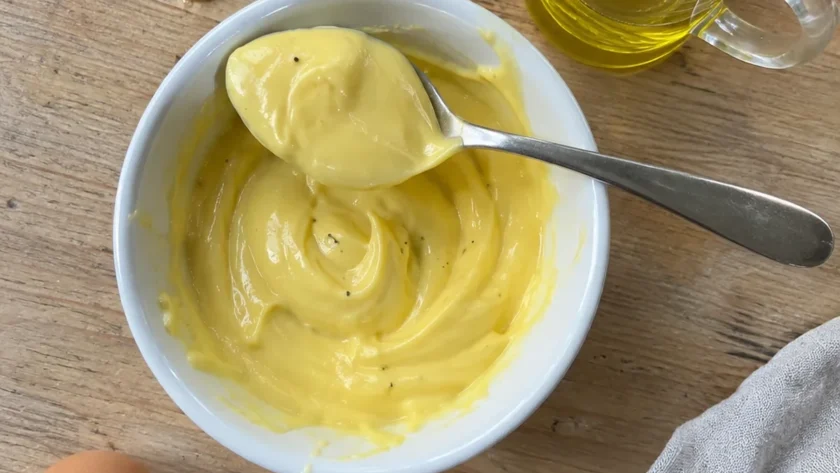

Making this Delia Smith mayonnaise recipe takes about 10 minutes with an electric hand whisk, and it gives you about 275ml of thick, wobbly sauce. You whisk 2 egg yolks with garlic and mustard, then add groundnut oil a drop at a time until the mixture thickens. A dessertspoon of white wine vinegar loosens it, and the olive oil goes in last as a thin stream.
Her website version comes from Delia’s Complete How to Cook and mixes 150ml of groundnut oil with 125ml of extra virgin olive oil. Her older books use 275ml of groundnut oil alone, as in the 1983 and 1992 Complete Cookery Course. The Winter Collection (1995) and How to Cook Book Three (published 2001) do the same. It is quicker than it sounds, because Delia timed the whole job at 7 minutes with a stopwatch for the 1992 book.
For a lighter mayonnaise, her website adds 1 tablespoon of boiled water at the end. The Winter Collection and How to Cook Book Three use 2 tablespoons of boiling water. Keep it in a screw-top jar at the bottom of the fridge, for no longer than a week. It is also the base of her prawn cocktail sauce in the Winter Collection (1995, page 46).
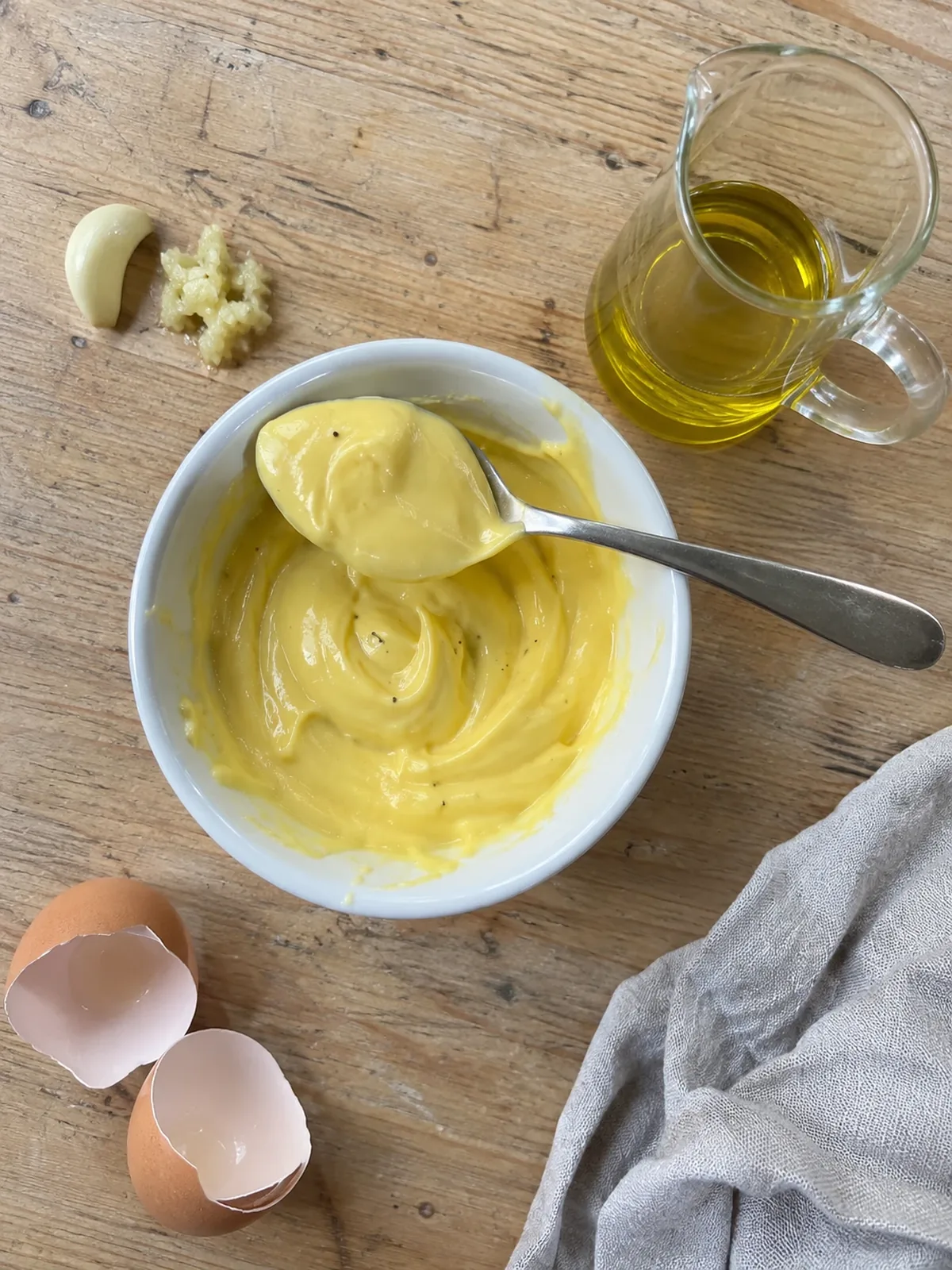
Delia Smith Homemade Mayonnaise
Course: SauceCuisine: FrenchDifficulty: Easy8
servings10
minutes290
kcalHer website mayonnaise, whisked by hand with groundnut oil first and olive oil last, until thick and glossy.
Ingredients
- For the mayonnaise:
2 large egg yolks
1 clove garlic, crushed
1 heaped teaspoon mustard powder
1 level teaspoon salt
freshly milled black pepper
150ml (5fl oz) groundnut oil
125ml (4fl oz) extra virgin olive oil
1 dessertspoon white wine vinegar
1 tablespoon boiled water (optional, for a lighter mayonnaise)
Directions
- Basin: Stand a small pudding basin on a damp tea cloth so it stays still. Measure the groundnut oil into one jug and the olive oil into another.
- Season: Put the yolks in the basin with the garlic, salt, a little black pepper and the mustard powder. Whisk them together well.
- Drop by drop: Hold the jug of groundnut oil in one hand and an electric hand whisk in the other. Add one drop of oil and whisk it in fully before you add the next.
- Vinegar: When about half the groundnut oil is in, the mixture turns very thick, stiff and lumpy. Whisk in the dessertspoon of vinegar to loosen it.
- More oil: Add the rest of the groundnut oil in larger drops. Then pour in the olive oil in a very thin, steady stream, whisking all the time.
- Taste: Taste it and add more salt, pepper or vinegar if it needs it. For a lighter mayonnaise, whisk in the tablespoon of boiled water.
- Store: Spoon it into a screw-top jar and chill it until you need it.
Notes
- Her traditional version uses 275ml of groundnut oil only, with about 1 teaspoon of white wine vinegar (Complete Cookery Course, page 438, 1992 edition).
- The mayonnaise has raw egg yolks. Eggs with the British Lion mark are safe to eat raw, the UK Food Standards Agency says.
- 8 servings of about 2 tablespoons each is my own guide.
FAQs
Which oil should I use?
Groundnut oil is the main oil in this mayonnaise, because it has very little taste of its own. Her website version uses 150ml of groundnut oil first, then finishes with the 125ml of olive oil. Her website also says strong oils make mayonnaise too harsh, so the olive oil only goes in once the sauce is thick.
If you cannot buy groundnut oil, her website says to use sunflower oil with extra virgin olive oil.
What size bowl do I need?
A small basin with a narrow base works best for mayonnaise, because the whisk can reach all of the yolks. Her Complete Cookery Course uses an 850ml basin (1992 edition, page 439). Her Winter Collection uses a 570ml pudding basin (1995, page 45).
Both books also put a damp tea cloth under it, to keep it steady. That leaves one hand free for the oil jug and one for the whisk.
What if it curdles?
Curdled mayonnaise can be saved with one fresh yolk in a clean basin. Add the curdled mixture to the new yolk drop by drop, whisking all the time. Then carry on with the rest of the oil as normal.
Delia gives this fix in the Complete Cookery Course, page 439 (1992), and on her website. She also gives the only cause, which is oil going in too fast at the start.
Which vinegar can I use?
White wine vinegar is the one Delia uses in this mayonnaise, and her website version needs one dessertspoon. Her website says never to use malt vinegar, because it is too harsh.
If you have no white wine vinegar, her website says cider vinegar or lemon juice will do. Add a little more at the end only if the taste needs it.
Is there a quick blender version?
There is a faster mayonnaise of hers, made with whole eggs in a food processor or liquidiser instead of yolks and a whisk. Her Instant Mayonnaise uses 2 of them (Complete Cookery Course, 1992, page 439), with the same garlic, mustard, salt and pepper. All 275ml of groundnut oil then goes in as a steady stream while the motor runs, and the vinegar goes in last.
It is not as thick, but she says it is better for tartare sauce. For one person, One is Fun (1987, page 172) uses 1 large egg with 150ml groundnut oil, and the job takes two minutes.
That book keeps it chilled for up to a fortnight, but any garlic goes in only just before you use it. She makes the green herb sauce for her whole baked salmon in this blender way too.
How do I make garlic mayonnaise or aioli?
This mayonnaise already has 1 crushed clove of garlic in it, so it is a gentle garlic mayonnaise, just like the one on her egg mayonnaise. Her website says you can leave the garlic out.
For aioli, use 4 cloves instead of 1, or more if you love garlic, with the same method. That aioli is on page 439 of the 1992 cookery course. In the south of France, she says, it is often served with fish or vegetables, so try it that way too.
Is there a low-fat version?
Yes, Delia’s low-fat mayonnaise is her Almost Mayonnaise, enough for 4 to 6. It is in the third of her How to Cook books (2001, page 126). It starts with 3 large eggs, boiled for exactly 9 minutes.
Only the yolks are used, pounded with 1 tablespoon of cold water, 2 pinches of cayenne and ¼ teaspoon of salt. Then you stir in 150ml of 8 per cent fat fromage frais and 4 teaspoons of white wine vinegar. After a couple of hours in the fridge it thickens, but it stays like thick cream rather than true mayonnaise.
She based it on Eliza Acton’s English Salad Sauce from the 1840s, which used double cream. Her Complete Cookery Course has that older sauce on page 440 of the 1992 edition.