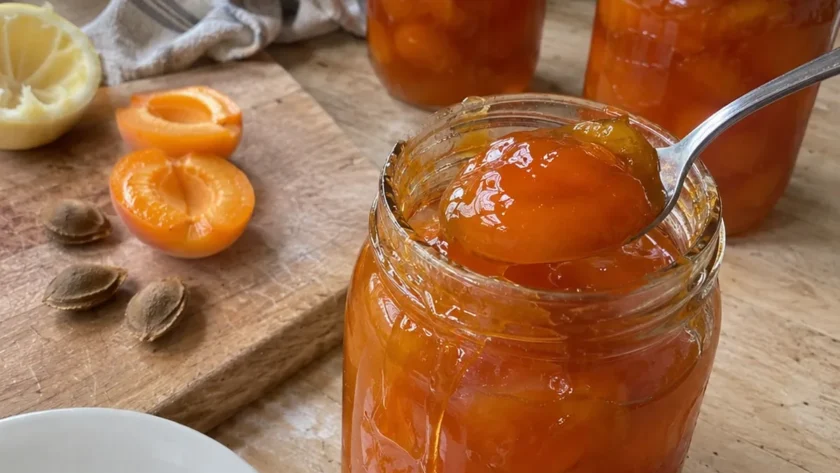

Delia Smith apricot jam is her Fresh Apricot Preserve, made with 900g of apricots, 900g of granulated sugar and the juice of a large lemon. You leave the halved fruit in the sugar overnight, then dissolve it slowly and boil it very fast until it sets. Next day the cooking takes 25 to 35 minutes, plus 15 minutes of settling, and fills three or four jars.
It is her mother’s recipe, printed in her Summer Collection (1993) on page 204. Every year her mother waited for apricot prices to drop, usually in August. That is when market stallholders sell off whole boxes cheaply at the end of a warm day.
Soaking the halves in sugar overnight firms them up, so the pieces stay whole in the jar. The sugar must then melt until it is completely clear before the fast boil, otherwise the jam turns out sugary. A smear of butter on the pan base stops it sticking, and a little more at the end clears the scum.
Store the sealed jars in a cool, dark cupboard, and keep an opened one in the fridge. Warmed and sieved, it is also the glue her 1992 book uses to fix Christmas cake marzipan in place.
Her Summer Collection pictures it on a toasted crumpet on a grey winter’s day. Warm scones from her fruit scones recipe work well with it too, and so does an autumn jar of our quince jelly.
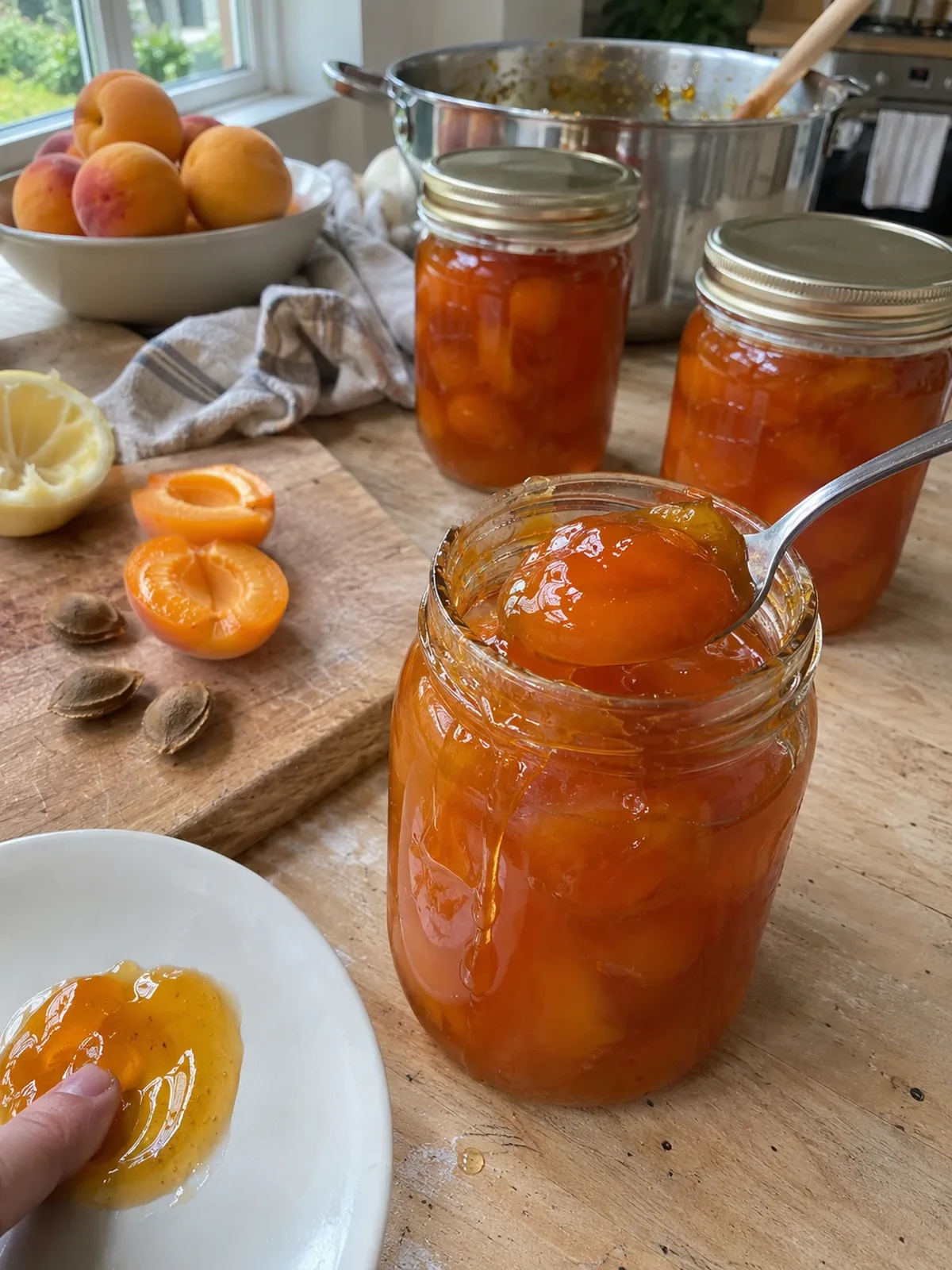
Delia Apricot Jam Recipe
Her mother’s recipe from the Summer Collection (1993): halved apricots left overnight in sugar and lemon juice, then boiled fast to a soft set.
3 to 4 jars
servings15
minutes35
minutes40
kcalIngredients
- For the jam:
900g apricots
900g granulated sugar
juice of 1 large lemon
about 25g butter
Directions
- Night before: Grease the base of a large casserole or small preserving pan with a smear of the butter. Halve the apricots and throw away the stones.
- Soak: Lay the apricot halves in the pan in layers, sprinkling the sugar between them. Add the lemon juice, cover with a clean cloth and leave overnight.
- Prepare: Next day, put 3 small plates in the freezer for testing. Wash the jars in warm soapy water, rinse them and heat them in a moderate oven for 5 minutes.
- Dissolve: Set the pan over a medium heat and let the sugar melt and dissolve completely, about 15 minutes. It must be clear, with no granules left.
- Boil: Turn the heat up as high as it goes and boil the jam very rapidly for 10 to 20 minutes. Stir it now and then so it does not stick.
- Test: Take the pan off the heat and put a teaspoonful of jam on a cold plate. After a few seconds, push it with your finger, and if a crinkly skin forms, it has set. If not, boil for 5 minutes more and test again.
- Pot: Stir in a trace of the remaining butter to clear any scum, then leave the jam to settle for 15 minutes. Pour it into the warm jars, seal while still warm and label when cold.
Notes
- Start the day before: the overnight soak in sugar is not counted in the times above.
- The calories are for a tablespoon (15g) of jam, not a whole jar.
FAQs
Which apricots are best for jam?
Firm, just-ripe apricots work best, because slightly under-ripe fruit holds more pectin and acid, as her 1992 jam rules explain. Weigh the 900g whole, with the stones still in, since the recipe halves them afterwards. Very soft, over-ripe fruit tends to break up in the boil, so we would avoid it.
What do I do with the stones?
Throw them away, because her website now leaves the apricot kernels out of this recipe. Her 1993 book cracked half the stones with a nutcracker, blanched and skinned the kernels, then stirred them in at the end. Raw apricot kernels contain a natural toxin, so leaving them out is also the safer choice.
Do apricots need pectin to make jam?
No, the recipe uses ordinary granulated sugar with no added pectin. Its lemon juice adds extra acid to help the set, following her 1992 rule of adding lemon to low-acid fruit. Apricots have a moderate amount of pectin, so the hard, fast boil does the rest.
How long should apricot jam boil?
Allow 10 to 20 minutes of very rapid boiling once the sugar has completely dissolved, stirring now and then. Riper fruit and a narrow pan usually need the longer time, which is our own advice. Start testing at 10 minutes, then boil in 5-minute bursts until a crinkly skin forms on a cold plate.
Why has my jam turned sugary?
Undissolved sugar is the usual cause, so the syrup must be completely clear before you turn up the heat. Her dried-apricot conserve recipe (2001) checks this by dipping in a wooden spoon and looking for granules in the liquid running off the back. Give it the full 15 minutes on a medium heat rather than rushing it.
Can I make it with dried apricots?
Yes, her winter Dark Apricot and Almond Conserve, from How to Cook Book Three (2001), starts with 450g of dried apricots soaked overnight. Next day they simmer in their 570ml of soaking water for about 30 minutes, then 450g of dark soft brown sugar dissolves in very slowly.
The juice of 4 lemons and 50g of roughly chopped unblanched almonds go in for a 15-minute fast boil. It fills three jars, and she serves it on warm scones or toasted crumpets.