
Delia Smith champagne jelly traps very cold champagne in a light lemon jelly, so tiny bubbles stay in every spoonful, and fills 6 glasses. You chill a lemon syrup set with gelatine until it is nearly set, then stir in 275ml of champagne and ladle it gently into glasses. Allow about 40 minutes of work, about an hour and a half for the first chill and 4 hours to set.
Our card follows Delia’s Happy Christmas (2009), page 208, where the jellies are topped with a brandy syllabub and sugar-frosted grapes. She is happy for you to use another sparkling wine, and suggests a sparkling Saumur. Her Delia Collection: Puddings (2006) also has a pink champagne version, one of her personal favourites.
Stand the glasses on a small tray in the fridge, as she suggests, so they don’t topple over while they set. Her website adds that they can be made a couple of days ahead, if the champagne is very well chilled and handled gently. Add the syllabub and grapes just before serving.
They are a light finish after a rich Christmas dinner, instead of or as well as her recipe for Christmas pudding. The same 2009 book also gives her panettone trifle recipe.
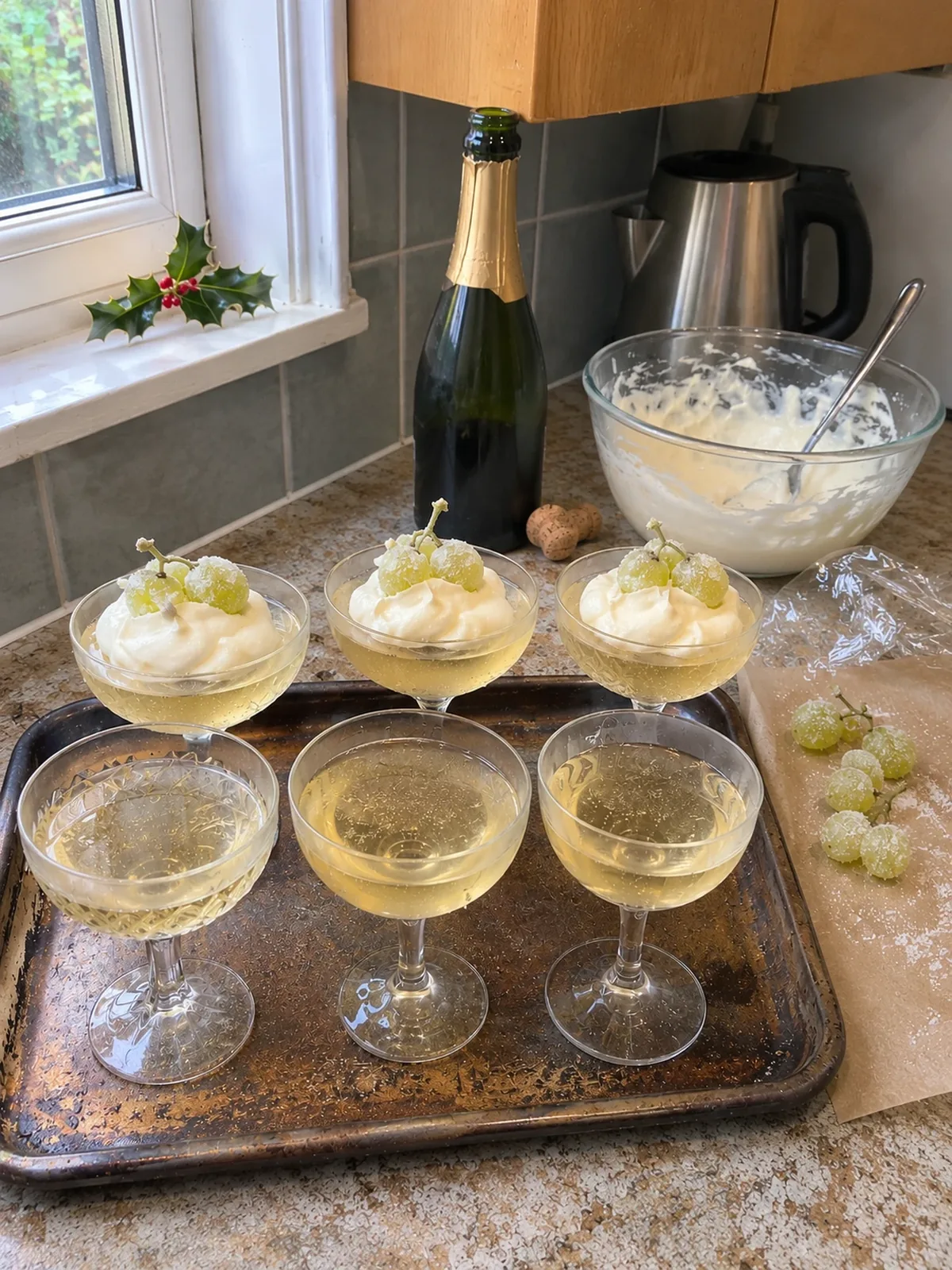
Delia Champagne Jellies
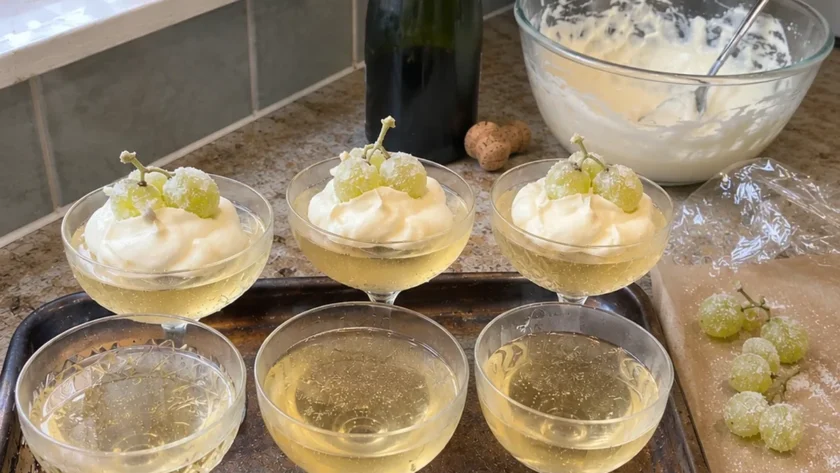
Champagne Jellies with Syllabub and Frosted Grapes from Delia’s Happy Christmas, set with sparkling wine and topped with cream and sugared grapes.
6
servings30
minutes10
minutes205
kcalIngredients
- For the jelly:
275ml champagne or medium-dry sparkling white wine, very well chilled
1 large lemon
85g caster sugar
10g leaf gelatine
450ml water
- For the syllabub:
1 tablespoon champagne or medium-dry sparkling white wine
½ tablespoon brandy
1 tablespoon lemon juice
10g caster sugar
75ml double cream
- For the frosted grapes:
110-150g seedless white grapes
1 egg white, beaten
caster sugar, for coating
Directions
- Grapes: Separate the grapes into clusters of two or three, still on the stalk. Wash and dry them well, then dip them in the egg white and caster sugar. Leave them on baking parchment to dry for a couple of hours.
- Syrup: Pour the water into a saucepan. Pare the lemon zest with a peeler and add it with the sugar, then bring it up to simmering point.
- Gelatine: Meanwhile, soak the gelatine leaves in cold water for 5 minutes. Take the pan off the heat, squeeze the water from the gelatine and whisk it in.
- Strain: Add the juice of the lemon and strain everything into a large bowl. Cool, cover and chill until just on the point of setting, 1 to 1½ hours, then give it a really good whisk.
- Champagne: Open the champagne, measure out 275ml and stir it into the jelly once or twice. Ladle it gently into the glasses, keeping as many bubbles as you can.
- Set: Set the glasses on a tray, cover them with clingfilm and chill for 4 hours, until softly set.
- Syllabub: Mix the champagne, brandy, lemon juice and sugar in a bowl, stirring now and then until the sugar dissolves. Pour in the cream, whisk it to soft peaks, then cover and chill.
- Serve: Just before serving, top each jelly with blobs of syllabub and decorate with the frosted grapes.
Notes
- The frosted grapes use raw egg white, so pasteurised egg white is safer for anyone pregnant, elderly or very young, in our view.
- The calories are for one jelly with its syllabub and grapes.
FAQs
Can I use prosecco instead of champagne?
Yes, a good dry or medium-dry sparkling wine works, and her 2009 book says a sparkling Saumur works very well. Prosecco is softer and a little sweeter, so taste the base and add a squeeze more lemon if you like, our own tip. Keep it very well chilled so it holds its bubbles.
Can I use powdered gelatine?
Yes, her pink champagne version in the 2006 Puddings book swaps its 5 sheets for an 11.7g sachet. Sprinkle the powder over 2 tablespoons of water in a small heatproof bowl set in a pan of simmering water. Take it off the heat, leave it for 10 minutes, then whisk it into the hot lemon syrup.
How do I keep the bubbles in the jelly?
Wait until the jelly has thickened and is about to set before the champagne goes in, then give it just a couple of stirs. Use a ladle rather than pouring, so that most of the bubbles survive. Champagne straight from a cold fridge also holds its fizz for longer.
Why is my champagne jelly rubbery?
After 4 hours the jellies should have a soft set, not rubbery but firm enough to hold the syllabub, as the 2009 book describes. A rubbery jelly usually means too much gelatine, so weigh the 10g carefully, which is our own advice. If it will not set at all, the base was probably too warm when the champagne went in.
What is her pink champagne version?
Her 2006 Puddings book makes 6 Pink Champagne Jellies with Champagne Cream in 150ml martini glasses. It uses 275ml of pink champagne, 5 sheets of gelatine, 425ml of water, a large lemon and 75g of golden caster sugar.
For the cream, about 6 tablespoons of champagne go straight from a freshly opened bottle into 150ml of softly whipped double cream. She makes it at the last minute, so you taste the bubbles.
What was her Old English Port Wine Jelly?
Delia Smith’s Christmas (1994) has a darker jelly for 8, made with 425ml of ruby port and 150ml of light red wine. A syrup of 150g sugar, 570ml water, whole spices and a lemon’s zest and juice is boiled. Three 11g sachets of powdered gelatine then set it.
Taste it before it sets, because it should be strong and sweeter than you would like, as the sweetness fades once chilled. Serve it slightly chilled, topped with frosted black grapes.