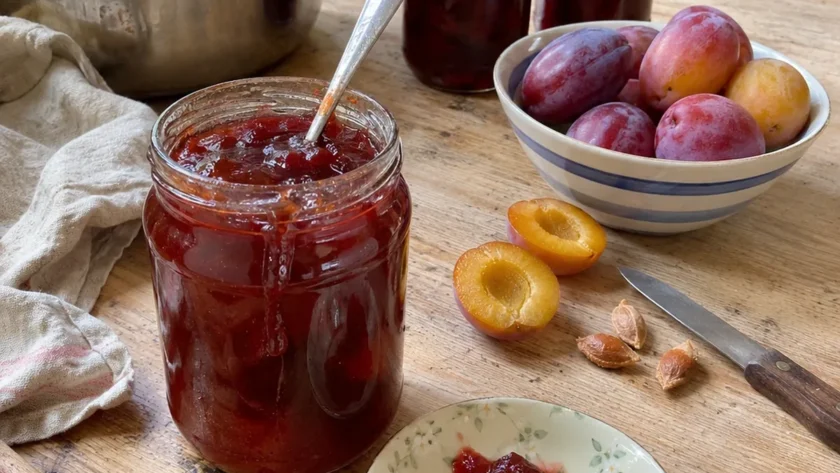

You stone and halve 900g of plums for Delia Smith plum jam, then simmer them in water until soft before the sugar goes in. It uses less sugar than fruit, 700g to 900g, and fills about 3 jars after a hard 10-minute boil. From stoning to potting, allow about 1¼ hours.
Her recipe shares one page of the Complete Cookery Course (1992) with her damson and blackcurrant jams. It is made the same way as her Loganberry Jam. The 1983 edition also prints exactly the same amounts. She has a small Victoria plum tree in her Suffolk garden (How to Cook Book Two). Those plums are her late-summer treat, eaten straight off the branches.
Plums turn up in her savoury preserves too, from a spiced plum chutney to a Victoria plum ketchup in that same 1992 book. Sealed jars of this jam keep well somewhere cool, dry and dark, which her jam rules recommend. Proper lids, she admits, are handier than cellophane once you start eating it.
For a softer summer jar, try her strawberry jam recipe. Damsons, the sharper cousin, make a tart damson jam and also bake into a good damson crumble.
Delia Plum Jam Recipe
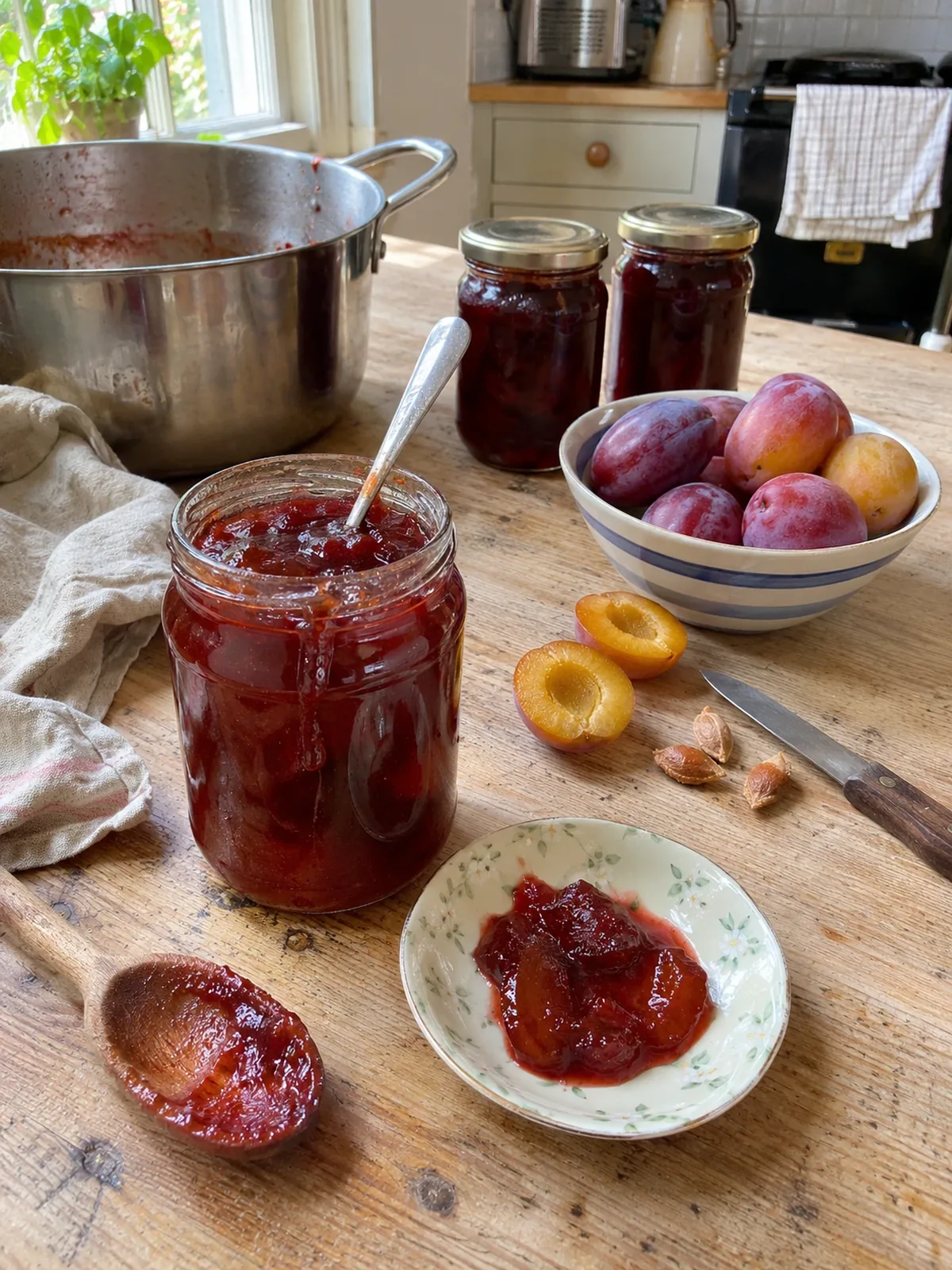
Her Plum Jam from the Complete Cookery Course: stoned, halved plums simmered soft, then boiled hard with less sugar than fruit.
3 jars
servings20
minutes40
minutes35
kcalIngredients
- For the jam:
900g plums, stoned and halved (weighed after stoning)
225ml water
700g granulated sugar
10g butter
Directions
- Prepare: Pre-heat the oven to 180°C, gas mark 4. Wash and dry four 450g jars, and put 4 small plates in the freezer to get really cold.
- Stone: Halve the plums, take out the stones and weigh out 900g of the halved fruit.
- Simmer: Put the plums and water in a large, wide pan and simmer gently until the skins are tender, about 15 minutes.
- Warm: As soon as the fruit goes on, tip the sugar into a bowl and warm it in the oven. Heat the jars in the oven for 5 minutes too.
- Dissolve: Add the hot sugar to the plums, stirring gently, then leave it on a low heat for about 15 minutes. Check the back of a wooden spoon for any sugar crystals.
- Boil: Once the sugar has gone, turn the heat right up and boil the jam rapidly for 10 minutes.
- Test: Take the pan off the heat and spoon a little jam onto a cold plate. When it is cool, push it with your little finger, and if a crinkly skin forms, it has set. If not, boil for 5 minutes more and test again.
- Pot: Stir in the butter, skim off any scum that is left and let the jam settle for 15 minutes. Pour it into the hot jars right to the top, cover with waxed discs, seal and label when cold.
Notes
- Weigh the plums after stoning, because her 900g is the weight of the halved fruit.
- The calories are for a tablespoon (15g) of jam, not a whole jar.
FAQs
Which plums make the best jam?
Firm, slightly under-ripe plums make the best jam, because they hold more pectin and acid than over-ripe ones, her 1992 book explains. Victorias are a good choice in late summer, while darker cooking plums give the jam a deeper colour.
Why is there less sugar than fruit?
Her jam rules say the amount of sugar depends on the fruit, and she prefers sharp fruits that the sugar does not overpower. So this jam uses 700g of sugar to 900g of plums, which keeps a real plum flavour.
Do plums need lemon juice?
Not in her recipe, which has none. Her rule is to add lemon only to fruit that is low in acid. Very sweet, ripe dessert plums may need the juice of a lemon to set well, which is our own tip.
Why simmer the plums before the sugar?
Plum skins are fairly tough, and her 1992 book says sugar has a hardening effect. So tough-skinned fruit must simmer until soft before any sugar goes in, or the skins stay chewy in the jar.
Why won’t my plum jam set?
It usually needs a longer, harder boil, so keep going in 5-minute bursts and test on a cold plate each time. If the jars are still runny once cold, the 1992 book’s fix is to reboil the jam with a small lemon’s juice.
Can I leave the stones in?
You can, but stoning first is easier, as her recipe does. If you cook them whole, skim off the stones as they float up during the boil. Weigh a little extra fruit to allow for the stones, which is our own method.