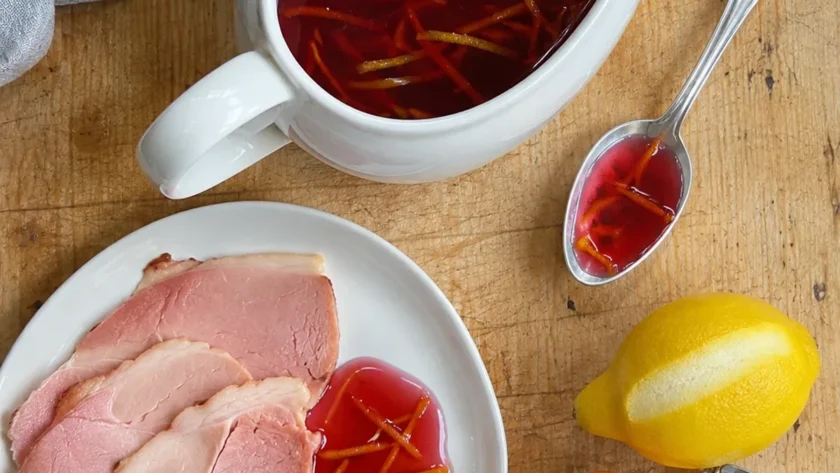

Traditional Delia Smith Cumberland sauce is a cold sauce of redcurrant jelly and port with orange, lemon, mustard and ginger, enough for 8 people. The jelly melts with the port, then goes into the citrus juices with fine strips of blanched zest. Allow about 25 minutes in all, with only 15 of them at the stove.
Delia’s Complete Cookery Course of 1992 calls this perhaps her favourite English sauce, for hot or cold gammon or tongue at Christmas (page 399). On page 222 she offers it with cold pressed tongue too, as an alternative to pickles and chutneys. Her first Complete Cookery Course of 1983 already had it, on page 442. The same recipe is on page 132 of Delia’s Happy Christmas (2009), which is the version on her website.
It goes with both of her gammons here too, the glazed gammon baked in foil and her 1983 gammon in cider. In The Delia Collection: Pork (2004), page 88, she calls it English Cumberland sauce. There it goes with a roast collar of bacon cooked like her blackened gammon, which she also makes for her Christmas Eve supper. She adds jacket potato wedges and Delia’s braised red cabbage.
Cumberland sauce is not the same as the Cumberland rum butter she serves with mince pies. That one is a sweet butter beaten with dark brown sugar and rum, served with the warm pies on page 78 of Delia’s Happy Christmas.
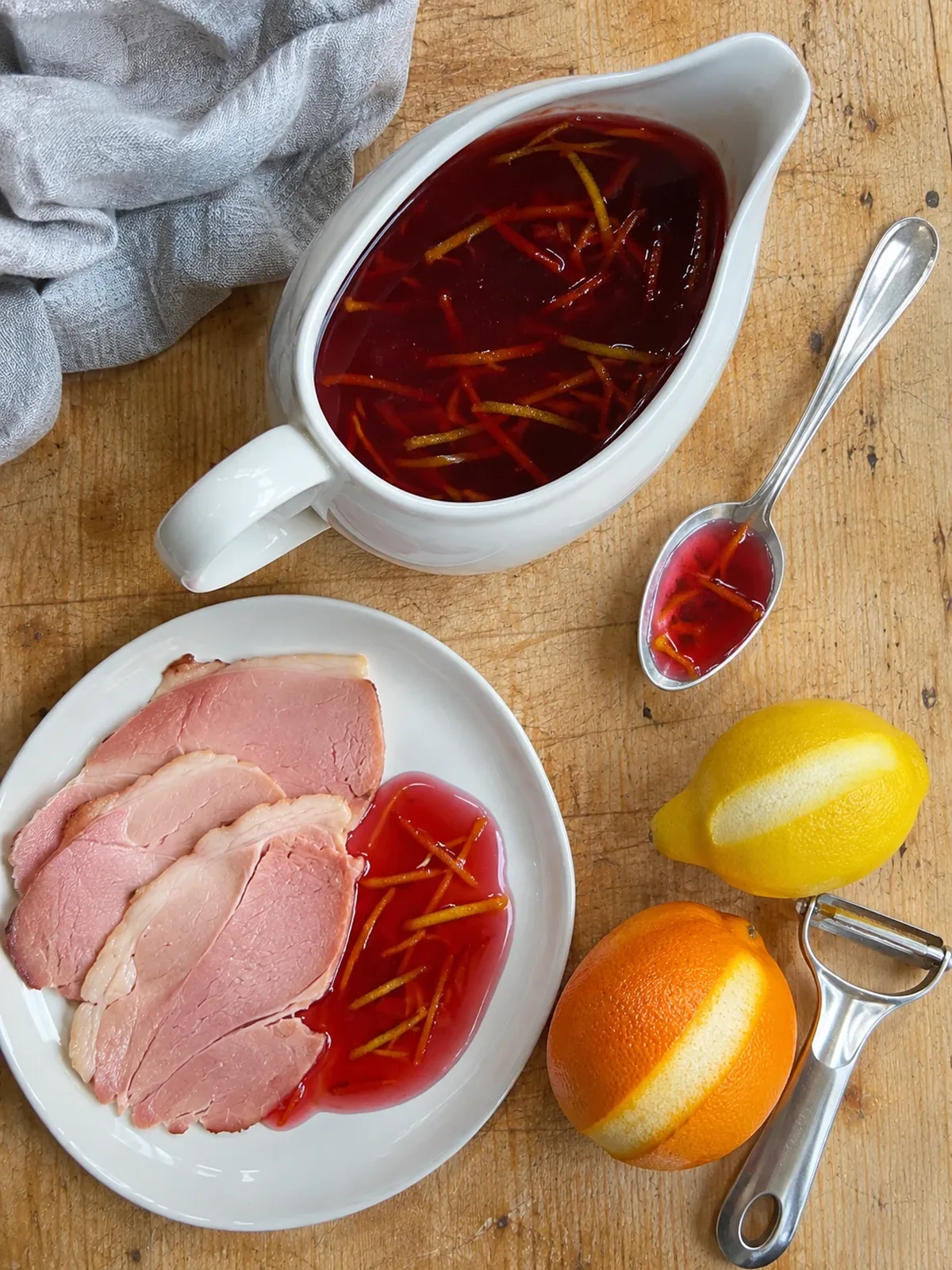
Delia Smith English Cumberland Sauce
A thin, glossy sauce made with redcurrant jelly melted in port, then sharpened with orange and lemon juice, mustard, ginger and fine strips of zest.
8
servings10
minutes15
minutes50
kcalIngredients
- For the sauce:
1 medium lemon
1 medium orange
4 heaped tablespoons good-quality redcurrant jelly
4 tablespoons port
1 heaped teaspoon mustard powder
1 heaped teaspoon ground ginger
Directions
- Zest: Pare the zest thinly from the lemon and the orange with a potato peeler. Cut it into very thin strips about 1cm long.
- Blanch: Boil the strips in a small pan of water for 5 minutes, then drain them well.
- Melt: Put the redcurrant jelly and the port in a saucepan and whisk them together over a low heat for 5 to 10 minutes.
- Sieve: Pass the jelly and port through a sieve.
- Mix: In a serving bowl, mix the mustard and ginger with the juice of half the lemon until smooth. Stir in the juice of the whole orange, then the jelly and port mixture, then the strips of zest.
- Serve: Whisk well and serve the sauce cold.
Notes
- Cumberland sauce keeps for 2 weeks in a screw-top jar in the fridge.
FAQs
Which redcurrant jelly should I use?
Choose a good-quality redcurrant jelly with a high fruit content for this Cumberland sauce. Delia warns that some shop jellies are short of fruit and too sweet, so check the label before you buy.
Her 1992 book asks for 4 large tablespoons of authentic jelly. The 2009 book asks for 4 heaped tablespoons and names Tiptree as the best.
How do I cut the zest so thin?
Pare the zest thinly with a potato peeler, or with a very sharp paring knife as her 1992 book suggests. Her Winter Collection (1995) shreds it into strips as fine as hairs, so take your time with a sharp knife on a board.
Why boil the strips of zest?
Boiling the strips of orange and lemon zest for 5 minutes takes away their bitterness, Delia explains. They stay in the finished sauce, so cut them as thin as you can.
Do I have to sieve the jelly?
Yes, sieving helps, because the redcurrant jelly never melts completely in the port. Her 1992 book and her website sieve it to catch the small stubborn lumps.
The 2009 book whisks it with a mini whisk over a low heat instead.
Can I serve Cumberland sauce warm?
No, Delia serves this sauce cold, even with hot gammon. Her 1992 book says plainly that Cumberland sauce is always served cold. Her website repeats that rule in its introduction to the recipe.
Can I make it with cranberry jelly?
Yes, Delia makes a cranberry Cumberland sauce for venison steaks in her Winter Collection (1995), page 81. It uses 2 rounded tablespoons of cranberry jelly with half a large orange and half a small lemon. Fresh root ginger, mustard powder and 3 tablespoons of port go in too.
That version is brought just to a simmer, and the port goes in off the heat. She pours it hot around the steaks, and makes it hours or even days ahead so the flavours develop.