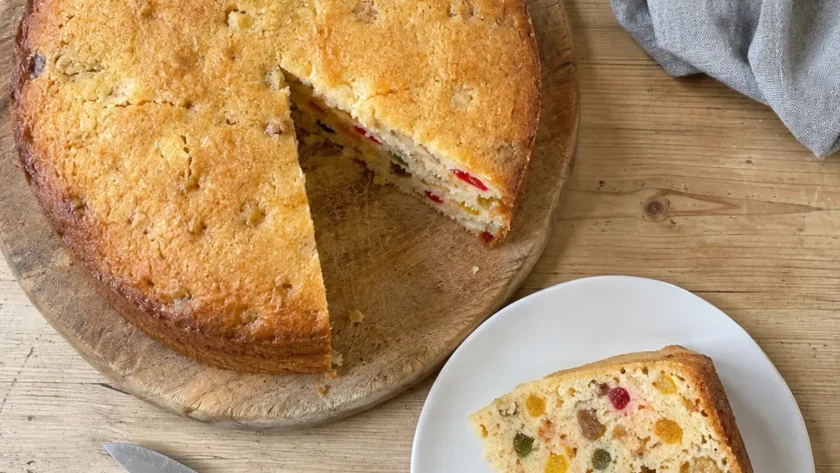

Jewelled Delia Smith light fruit cake is her pale Christmas cake, full of glacé pineapple, apricots, coloured cherries, walnuts and sultanas. You whisk the mixture in one bowl, fold in the fruit, then bake it in a 20cm tin for 3 hours. Allow about 220 minutes plus cooling in the tin, and one cake gives about 16 slices.
Delia first wrote this cake for her Book of Cakes (1977), for anyone who wants something paler and lighter than a traditional Christmas cake. In Delia Smith’s Christmas (1990), she calls her glacé version a cake for connoisseurs. Today it is the Light Christmas Cake in Delia’s Cakes (2014), which is also the recipe on her website.
A light Christmas cake does not mature with keeping the way a dark one does, her website says. It still keeps longer than a cherry cake or her Dundee cake, because its share of fruit is still quite high. Her website team usually eats it within 3 weeks, and it freezes very well if you bake it sooner.
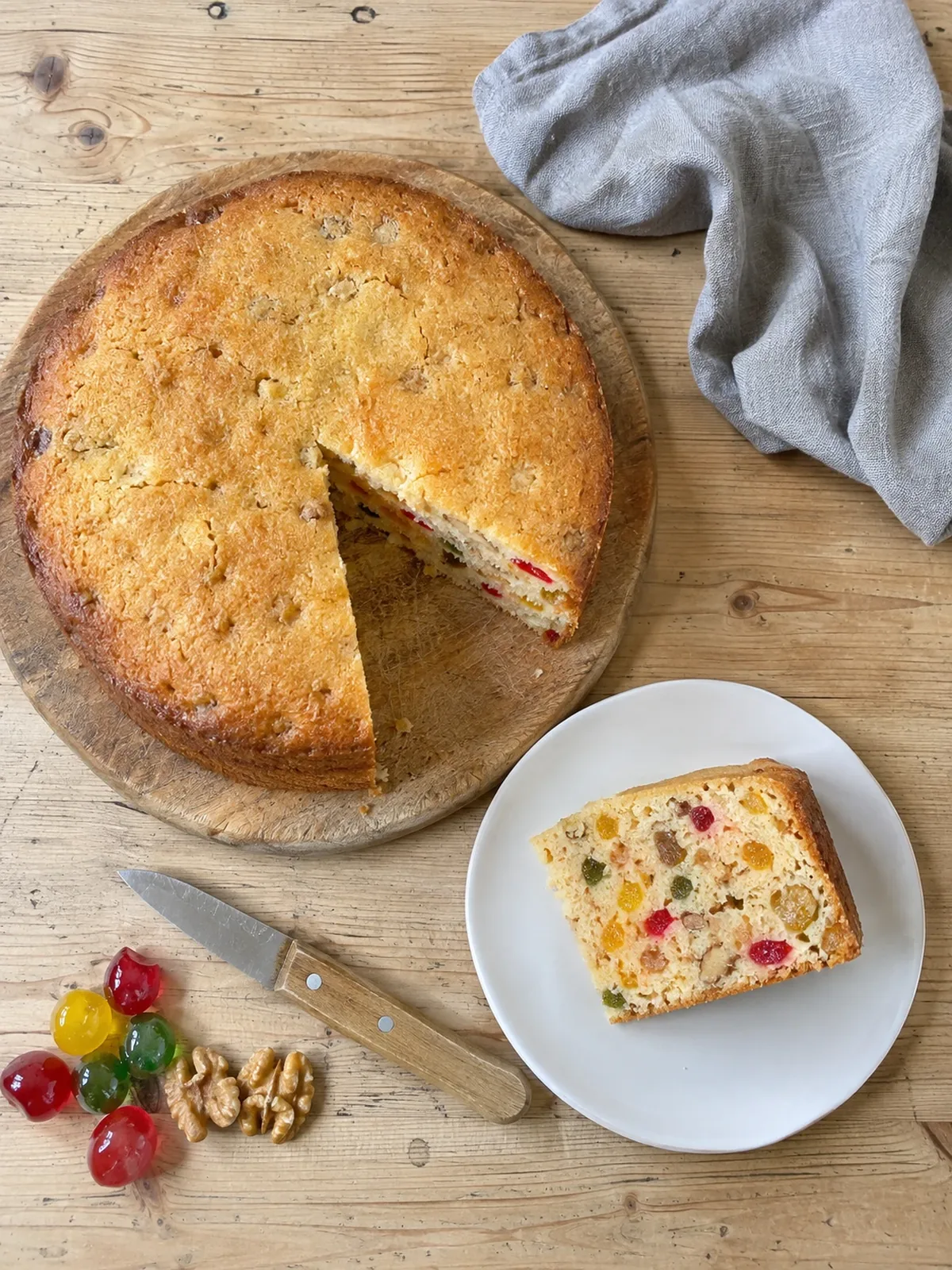
Delia Smith Light Christmas Cake with Pineapple
A pale, buttery fruit cake full of chopped glacé pineapple, cherries, apricots, angelica and ginger, with walnuts and a little brandy.
16
servings40
minutes3
hours445
kcalIngredients
- For the fruit and nuts:
110g walnuts
110g glacé pineapple
110g ready-to-eat dried apricots
175g glacé cherries (red, green and yellow), rinsed and dried
225g sultanas
110g candied peel
50g angelica
50g crystallised ginger
- For the cake mixture:
225g plain flour
225g golden caster sugar
50g ground almonds
¼ teaspoon salt
225g spreadable butter
4 large eggs
3 tablespoons brandy
grated zest of 1 orange and 1 lemon
1 tablespoon lemon juice
Directions
- Oven: Heat the oven to 170°C, fan 150°C, gas mark 3. Grease a 20cm loose-based round cake tin and line the base and side with baking parchment.
- Chop: Chop the walnuts fairly finely. Cut the pineapple, apricots and cherries to about the size of a sultana, and the peel, angelica and ginger a little smaller.
- Whisk: Sift the flour into a large, roomy bowl, then add the sugar, ground almonds, salt, butter, eggs and brandy. Whisk with an electric hand whisk for about 1 minute, until smooth and creamy.
- Fold: Fold in all the fruit and nuts, the orange and lemon zest and the lemon juice. Spoon the mixture into the tin and level the top with the back of the spoon.
- Wrap: Tie a band of brown paper around the outside of the tin. Set the tin in the oven so its top sits roughly in the centre.
- Bake: Bake for 1 hour, then lay a double sheet of baking parchment over the top, resting on the lining. Turn the oven down to 150°C, fan 130°C, gas mark 2, and bake for 2 hours more. The centre should feel springy when you press it lightly with a little finger.
- Cool: Leave the cake in the tin until completely cold. Take it out, peel off the papers, wrap it in parchment-lined foil and store it in an airtight tin.
FAQs
Can I use crystallised pineapple instead of glacé?
Yes, crystallised pineapple is a good substitute for the glacé pineapple, her website says. A reader asked because glacé pineapple and angelica can be hard to find in local shops.
Does it need feeding with brandy?
No, this light Christmas cake needs no feeding, according to her website. The only brandy is the 3 tablespoons whisked into the mixture before baking.
How should I decorate it?
Her website tops the light Christmas cake with her apricot and pecan topping. In her 1990 Christmas book, Delia says the cake also works well with marzipan and icing, or with a glacé fruit and nut topping.
What is different in her Light Glacé Fruit Cake?
Her Light Glacé Fruit Cake, from Delia Smith’s Christmas (1990), uses pecans instead of walnuts. You soak the sultanas and apricots in the brandy overnight. Then you cream unsalted butter with caster sugar and beat in the eggs a little at a time.
It bakes for 1 hour at 170°C, then at 150°C for a further 2 to 2¼ hours, in a 20cm round or 18cm square tin. The first 1977 printing also creams the mixture, with walnuts and glacé apricots, and bakes for the same time.
Light Christmas cake sizes from her website
Her website gives these sizes for the 2014 recipe. Each cake still bakes at 170°C first, then is covered with parchment and finished at 150°C.
| Tin | Mixture | Baking time |
|---|---|---|
| One 15cm round | Half the recipe (2 eggs) | 45 minutes at 170°C, then 1¼ hours at 150°C |
| Two 15cm rounds, side by side on one shelf | The full recipe, divided | 45 minutes at 170°C, then 1¼ hours at 150°C |
| 20cm round (the card) | The full recipe (4 eggs) | 1 hour at 170°C, then 2 hours at 150°C |
| 23cm round | 1½ times the recipe (6 eggs) | 1 hour at 170°C, then 150°C for 2¾ to 3 hours |
| 30cm round, for a wedding | A 10-egg mixture | About 4 hours in all (her website’s estimate) |