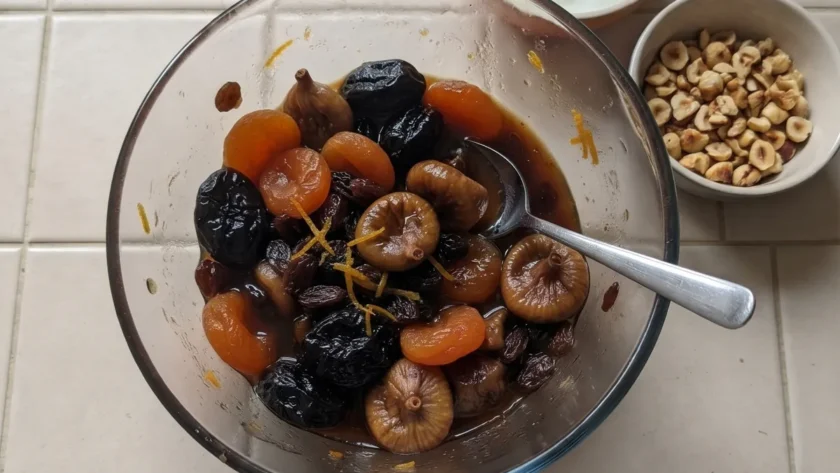

Delia Smith’s winter fruit salad is a dried fruit salad: prunes, apricots, figs and raisins soaked in cold water overnight, simmered briefly until plump, then finished with the zest and juice of an orange and chilled. Natural yoghurt and toasted hazelnuts go with it, and it serves 4 to 6.
It’s her Dried Fruit Salad with Yoghurt and Nuts from the Complete Cookery Course, which she pitches at anyone wholefood-minded. The first edition in 1983 cooked the fruit with 50g of demerara sugar, but by 1992 she had decided it tastes better with none at all, so the card follows her later book.
Soaking and then simmering the fruit in its own water gives you a thick, dark, naturally sweet syrup, and the orange stirred in at the end gives it a bright, sharp edge. Cold from the fridge, you get soft, sticky figs and prunes, tangy apricots, cool yoghurt and the crunch of toasted nuts.
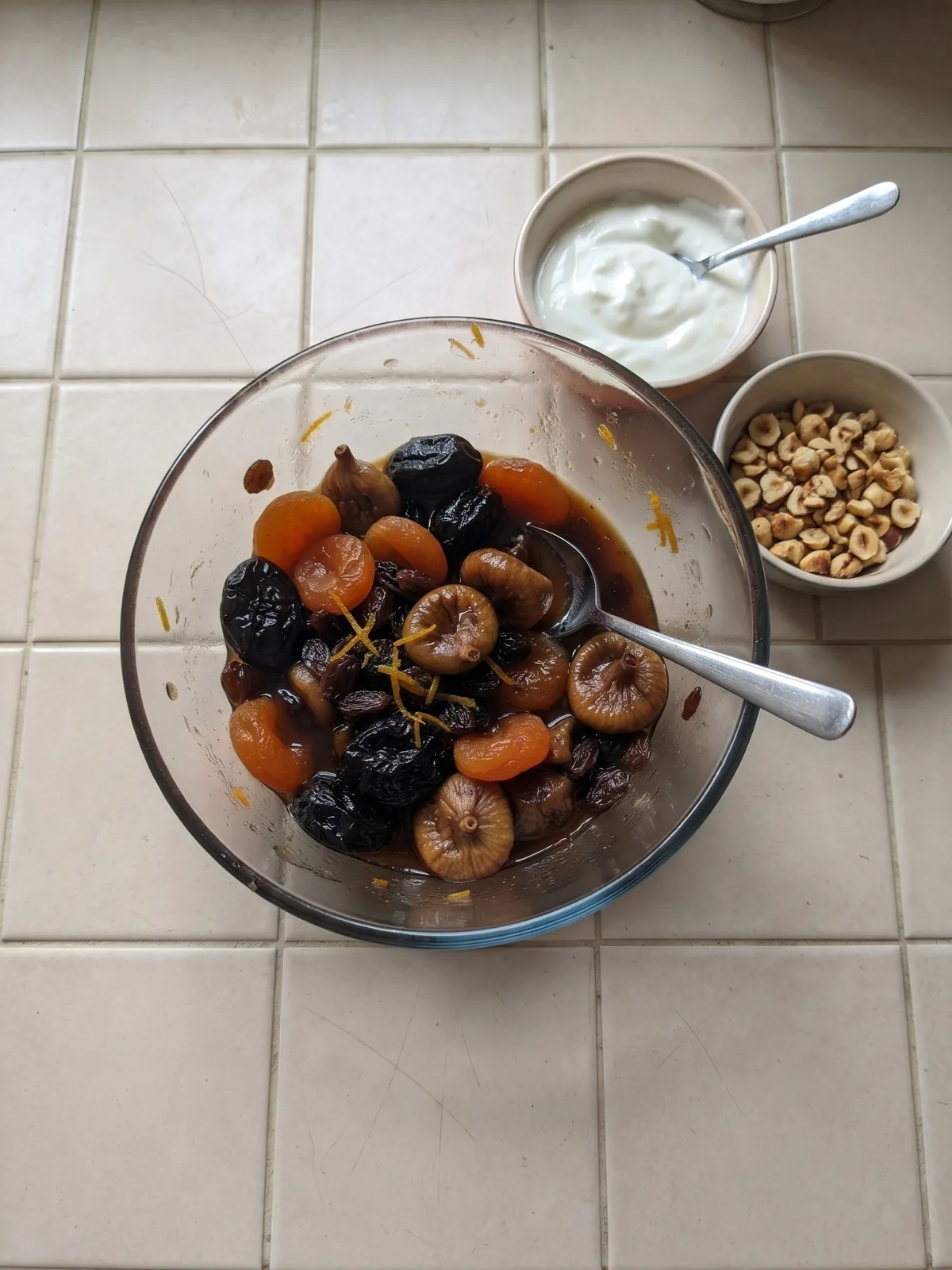
Delia Smith’s Dried Fruit Salad with Yoghurt and Nuts
The no-sugar version from Delia’s Complete Cookery Course (1992), page 491, made with four dried fruits and an orange. These ingredients serve 4 to 6, with the yoghurt and hazelnuts handed round at the table.
4
servings9
hours10
minutes15
minutes440
kcalIngredients
- For the fruit:
110g (4oz) prunes
110g (4oz) dried apricots, separated
110g (4oz) dried figs, hard stalk ends cut out
110g (4oz) large raisins, separated
grated rind and juice of 1 orange
- To serve:
425g (15oz) natural yoghurt
50g (2oz) hazelnuts, chopped and toasted
Directions
- Soak: The night before, put the four dried fruits in a deep 1.5 litre (2½ pint) bowl and pour over 725ml (1¼ pints) of cold water. Check that all the fruit is under the water, then leave it to soak overnight.
- Drain: Next day, pour off 75ml (3fl oz) of the soaking water.
- Simmer: Tip the fruit and the rest of the water into a small pan, cover and bring up to simmering point. Simmer gently for about 10 minutes, until every piece feels tender when you push in a skewer.
- Orange: Stir in the grated orange rind and juice.
- Chill: Tip everything into a shallow serving bowl and leave it to cool, then cover with cling film and chill.
- Serve: Spoon the fruit and its syrup into dishes, and pass round the yoghurt and toasted hazelnuts separately.
Notes
- The prep time counts about 8 hours for the overnight soak and an hour to cool and chill, and the hands-on work is about 10 minutes.
- To toast the hazelnuts, shake them in a dry frying pan over a medium heat for a few minutes until golden, which is my own method.
- Covered in the fridge, the fruit keeps well for up to 3 days by my own reckoning, and the syrup thickens as it sits.
FAQs
Why is there no sugar in it?
Because Delia found it tastes better without. Her first edition of the Complete Cookery Course simmered the fruit with 50g (2oz) of demerara sugar, and when she revised the book she took it out.
The dried fruit is sweet enough on its own, and the syrup it makes while it simmers is rich and dark. If you’d like it sweeter, add the 1983 amount of demerara to the pan with the fruit.
Do I have to soak the fruit overnight?
Yes, as the long soak is what plumps up the dried fruit before its short simmer. Delia’s one warning is to make sure every piece is under the water, so use a deep bowl and push down any figs that float.
Pouring off 75ml of the water the next morning keeps the syrup thick rather than thin and watery. Then 10 minutes of simmering is enough, and the skewer test tells you when the fruit is soft all the way through.
Should the yoghurt go on top?
Not necessarily, as Delia has served it both ways. In the 1983 edition she spread the yoghurt over the fruit and scattered the hazelnuts on top just before serving, while in 1992 she hands both round separately.
Serving them on the side lets everyone take as much as they like, and the nuts stay crunchy for longer. Thick Greek-style yoghurt holds its shape best if you do spread it over, which is my own tip.
Can I make a small amount for one?
Yes, with her prune and apricot compote from One is Fun, written for cooking for one. It uses 25g (1oz) each of prunes and raisins, 50g (2oz) of dried apricots, half an orange and 150ml (5fl oz) of water, soaked overnight and simmered in the same way.
That version does keep a rounded dessertspoon of demerara sugar, and it’s served with 2 tablespoons of yoghurt and 10g of toasted hazelnuts. She points out that whatever dried fruit you don’t use keeps happily in the cupboard.
How is it different from her other fruit salad?
It’s a different recipe from the same book. Her fresh fruit salad uses oranges, grapes, pineapple, apples, pears and bananas in a sugar syrup with lemon and rum, served chilled for 8.
This one is made entirely from storecupboard dried fruit, with no sugar or alcohol, so it suits the winter months when the fruit bowl is at its dullest. Any leftovers make a good breakfast with the yoghurt, which is how I’d use them up.