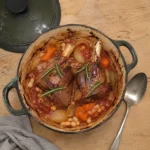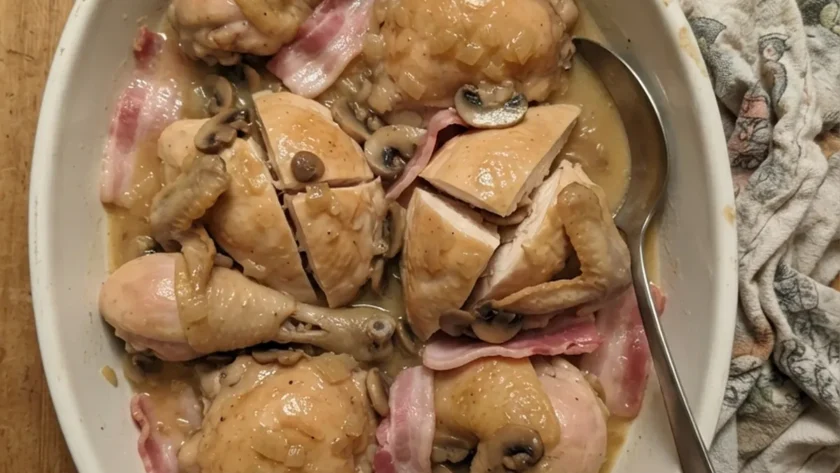

An hour of gentle simmering in dry cider is all Delia Smith’s chicken in cider needs, with streaky bacon, onions, thyme and a bay leaf in the pot alongside eight chicken joints. Mushrooms go in near the end, a little butter and flour turns the cider into a smooth sauce, and it makes an autumn supper for 4.
Her 2003 book The Delia Collection: Chicken puts it in the autumn chapter, and it’s the only one of her books I’ve found it in. She serves it with crisp, buttered jacket potatoes and spiced red cabbage.
Read the recipe in the book and you’ll see it asks you to heat the oven to gas mark 4, yet the method never puts anything in it. Everything simmers on the hob in one lidded casserole, so the card below leaves the oven out.
What comes out is tender chicken in a smooth, glossy sauce, tangy from the cider and salty from the bacon, with sliced mushrooms soaking up the lot.
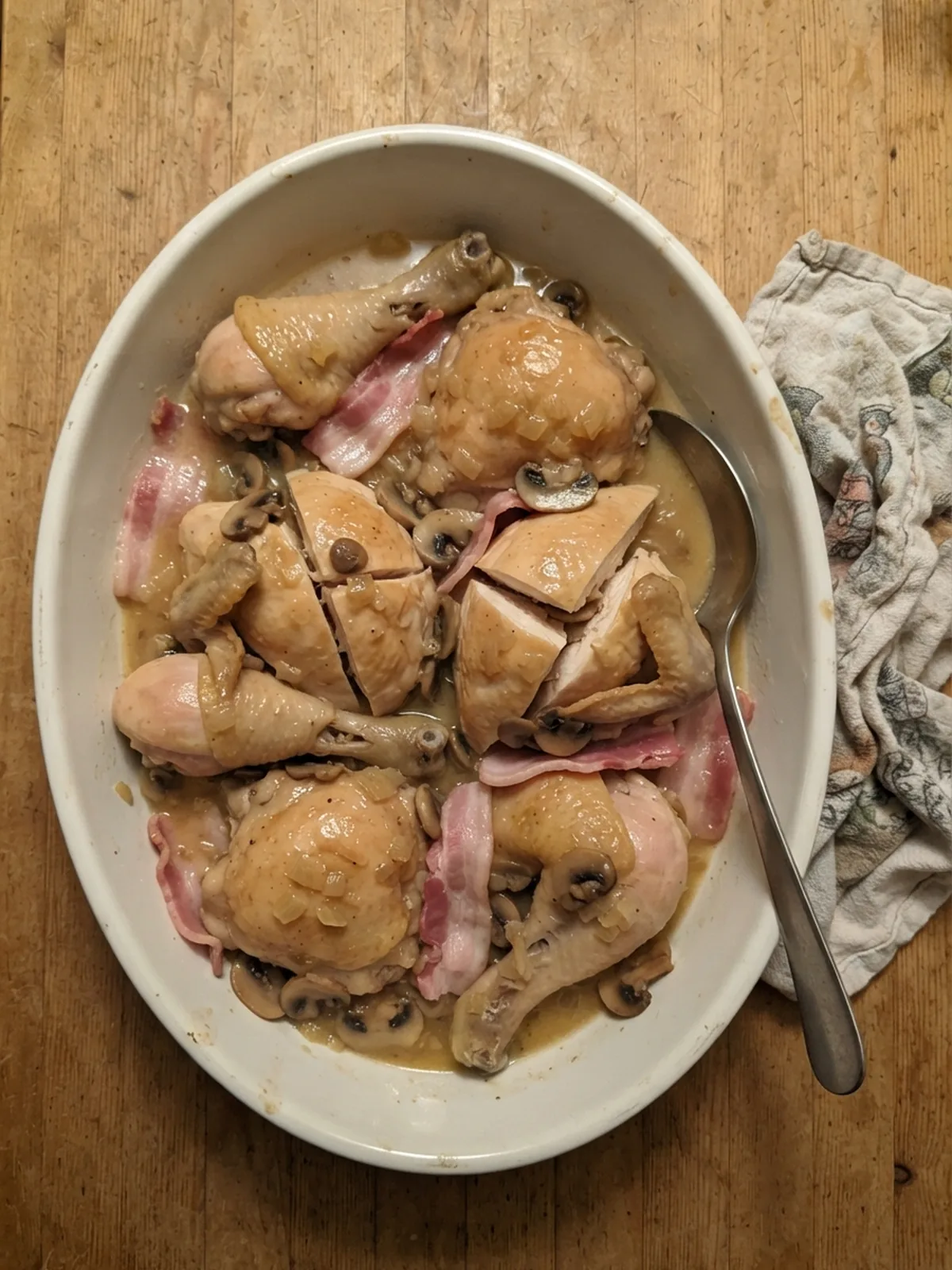
Delia Smith’s Chicken in Cider
Course: DinnerCuisine: BritishDifficulty: Easy4
servings20
minutes1
hour30
minutes815
kcalA jointed chicken braised in a pint of dry cider with bacon and herbs, the sauce thickened at the very end and spooned over the chicken.
Ingredients
- For the casserole:
1 chicken of 1.35kg (3lb), jointed into 8 pieces
2 tablespoons groundnut or other flavourless oil
2 medium onions, chopped
1 clove garlic, chopped
6 rashers unsmoked streaky bacon
1 sprig of fresh thyme
1 bay leaf
570ml (1 pint) dry cider
225g (8oz) dark-gilled mushrooms, sliced
salt and freshly milled black pepper
- For the sauce:
25g (1oz) plain flour
25g (1oz) softened butter
Directions
- Brown: Heat the oil in a 3.5 litre (6 pint) lidded flameproof casserole over a high heat and season the chicken joints. When the oil shimmers, brown the chicken in two batches until every piece is golden all over, moving the first batch to a plate while the second one cooks.
- Onions and bacon: Fry the onions and garlic in the same pot for about 5 minutes. Add the bacon and fry it just until some of its fat melts.
- Simmer: Put all the chicken back in with the thyme and bay leaf, then pour in the cider and bring it up to a simmer. Cover and let it simmer gently for 1 hour.
- Mushrooms: Stir in the mushrooms and simmer for another 5 to 7 minutes, until they’re cooked.
- Paste: Meanwhile, mash the flour and butter together into a smooth paste.
- Thicken: Lift the chicken onto a warm serving dish with a slotted spoon and fish out the thyme and bay leaf. Add the paste to the liquid and bring it back to a simmer, stirring all the time, until the sauce thickens.
- Serve: Pour the sauce over the chicken and serve straight away.
Notes
- Her casserole notes put a lot of weight on a well-fitting lid, so less of the cider boils away, and a sheet of foil under a loose one helps. Before thickening, check the biggest thigh by the bone for any pink, and 75°C on a probe is my own extra check.
FAQs
Which cider should I use?
A dry one. The casseroles section of her Complete Cookery Course rates cider highly in a casserole, but only if it’s dry, and this recipe asks for a whole pint of it.
Sweet cider or apple juice would leave the sauce sugary, so I wouldn’t swap either in, my own view. For an alcohol-free version I’d use chicken stock with a tablespoon of cider vinegar, which is my own idea rather than hers.
What does the flour and butter paste do?
It thickens the sauce at the end. The same Complete Cookery Course pages give the rule: 25g of butter worked into 25g of flour will thicken 570ml of liquid, which is exactly the amount of cider here, and its classic French name is beurre manié.
Add it in small flecks, whisking with a balloon whisk as you go. She also notes that the paste can be frozen in blocks in an ice-cube tray, which is handy if you make casseroles often.
Do I need to joint a whole chicken?
No. Eight bone-in thighs and drumsticks, about 1.35kg in all, cook just as well here, a swap of my own rather than the book’s.
If you’d like to joint a bird, her method gives 2 drumsticks, 2 thighs and 4 breast pieces, and our chicken cacciatore page goes through it step by step.
Why brown the chicken in two batches?
So it browns instead of steaming. Her casserole notes warn never to crowd the pan, because the steam leaves the meat damp and it won’t colour, so only a few pieces go in at a time.
She also sears over a high heat rather than a medium one, for a dark crust and a richer sauce. Any juices left on the plate should go back into the pot with the chicken.
Can I start it the day before?
Yes. Her note under the coq au vin recipe in the Complete Cookery Course splits the cooking over two days, with half the simmering the day before, then cooling, chilling overnight and the rest before serving, turning the pieces at the halfway point.
Here that means 30 minutes on the first day and 30 on the second, my own split, with the mushrooms and the thickening left until the end. Cool it quickly and chill it, covered, overnight.
Can it go in the oven or a slow cooker?
Yes, though both are my own adaptations, as the book keeps it on the hob. For the oven, bring it to a simmer at step 3, cover it and give it about 1 hour at 180°C (160°C fan), gas mark 4, the temperature printed on the page, then finish the mushrooms and sauce on the hob.
Her Complete Cookery Course times a casserole in a slow cooker at around 5 hours on high or 8 on low. For chicken joints, browned first, I’d keep it to 4 to 6 hours on low, my own call, and our chicken casserole slow cooker page covers that way of cooking in more detail.