 Anne Morgan
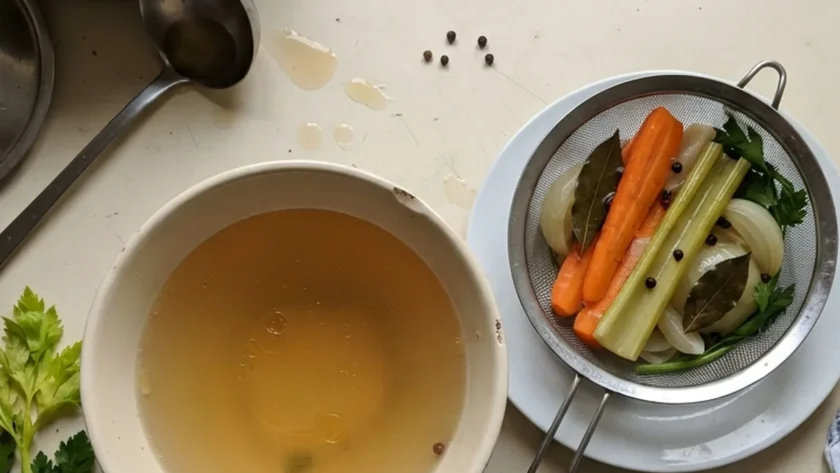
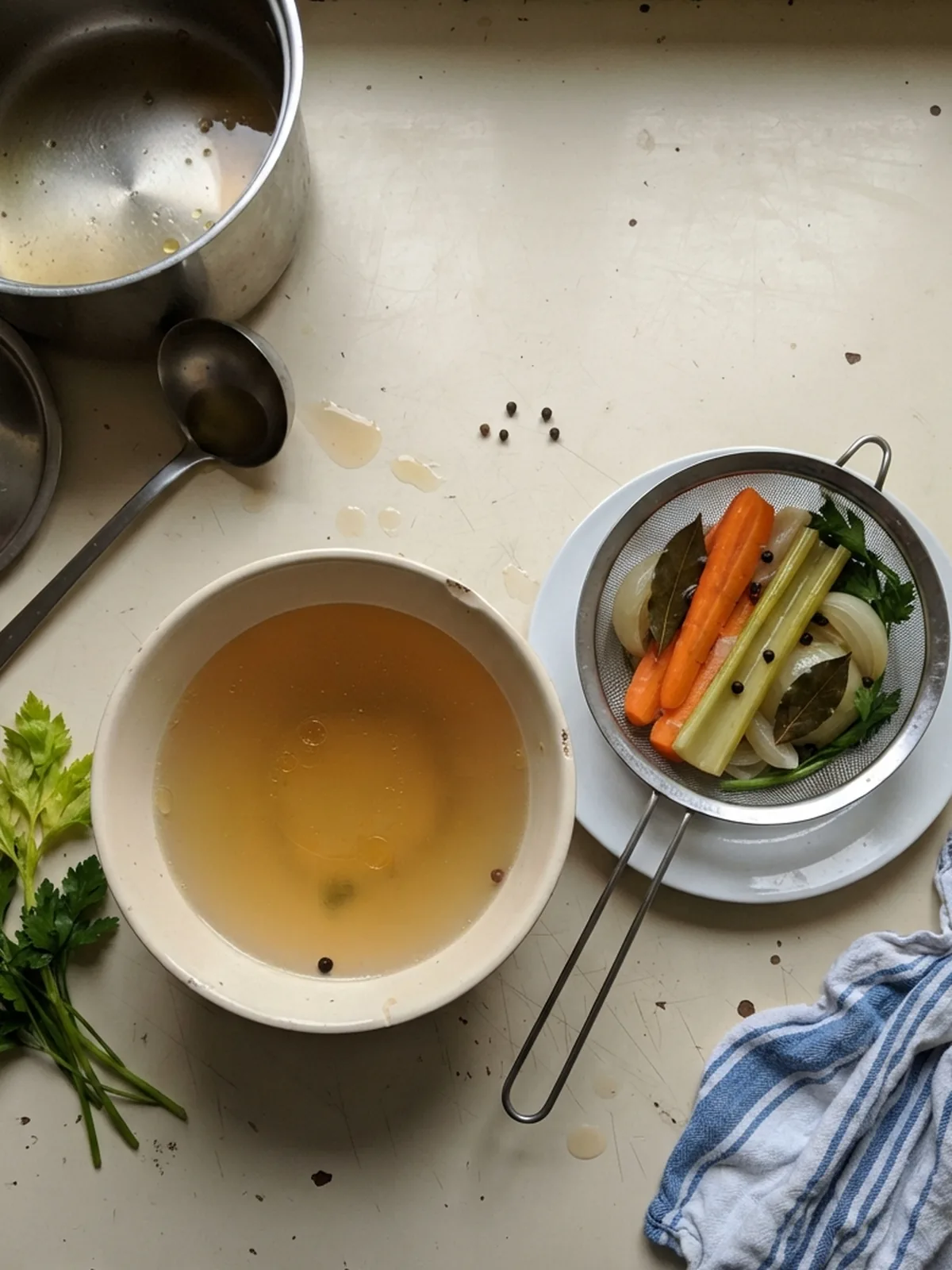
Two small carrots, two small onions and a stick of celery make Delia Smith’s vegetable stock, with bay leaves, peppercorns and parsley stalks for flavour. Everything boils briskly under a lid for 30 minutes and is then strained, leaving about 570ml of light stock for a soup.
Her Winter Collection (1995) opens its soup chapter with it, set out for readers without her other books. The Delia Collection: Soup (2003) gives it again, with the same amounts, in its stocks and garnishes pages.
It’s the one to reach for in her meat-free soups. Her vegetable mulligatawny, for instance, takes 850ml of it.
The result is pale gold and smells of bay and pepper. It sits in the background of a soup rather than taking it over.
Delia Smith’s Quick Vegetable Stock
Course: SoupsCuisine: BritishDifficulty: Easy4
servings10
minutes35
minutes10
kcalLight, clear and gently peppery, a 30-minute base for vegetable soups.
Ingredients
- For the stock:
1 stick of celery, cut in half and split lengthways
2 small carrots, split in half lengthways
2 small onions, sliced
1 small bunch of parsley stalks and celery leaves
a pinch of salt
570-850ml (1-1½ pints) cold water
Directions
- Prepare: Cut the celery stick in half and split it lengthways, split the carrots in half lengthways and slice the onions.
- Boil: Put everything in a saucepan with the cold water, cover with a lid and bring to the boil. Keep it boiling briskly for 30 minutes.
- Strain: Pour it through a sieve into a jug or bowl and throw away the vegetables. The stock is ready to use.
Notes
- Using the full 850ml of water gives you more stock with a lighter flavour, which is my own note. The smaller amount gives a stronger one.
- Cool it quickly, cover it and keep it in the fridge for up to 3 days.
FAQs
Can I use stock powder instead?
Yes, and she rates it herself. The same Winter Collection chapter calls Marigold’s powdered vegetable stock, which is gluten-free, an excellent standby for the store cupboard.
She also points out that the tubs of ready-made stock sold in supermarkets get expensive if you need a lot. Many of her later recipes simply ask for hot stock made with Marigold Swiss vegetable bouillon powder.
Do I always need stock for a soup?
Not in her view. In One is Fun (1987) she says fresh ingredients carry plenty of flavour of their own, and that a strong stock or a stock cube can drown it, as cubes nearly always bring a taste she finds out of place.
For most of her soups for one, she says plain water is enough. This 30-minute stock is there for anyone who can’t bring themselves to use water.
How long does vegetable stock keep?
Up to 3 days in the fridge, by my own rule, or a few months in the freezer. Her Complete Cookery Course suggests one occasional stock-making session and freezing any surplus to use later.
I’d freeze it in 570ml tubs, which is the amount many of her soups need, plus a few ice cubes’ worth for sauces.
How is it different from the chicken version?
Only the giblets and the time. Beside it in the Winter Collection, her chicken giblet stock uses the same celery, carrots, onions, bay, peppercorns and parsley, plus a set of chicken giblets or a couple of chicken wing tips, in 1.2 litres of water.
That one boils briskly for 1 hour instead of 30 minutes. It’s the same family as her one-hour chicken stock.
Which soups use it?
Most of the vegetarian ones. Her slow-cooked celeriac soup and her watercress soup both call for vegetable stock.
Her Puy lentil soup in the 2003 Soup book uses it too, swapping the home-made stock of her older version for vegetable.
How much salt should go in?
Just the pinch in her list, as the soup gets seasoned later. In the soup chapter of her Complete Cookery Course she warns against over-seasoning when the stock is already seasoned, or when a stock or soup is reduced, because the salt concentrates with the flavour.
She recommends tasting and seasoning right at the end. If a soup does end up too salty, she adds more unsalted liquid, or cooks a couple of halved raw potatoes in it to soak some up, then lifts them out before serving.
Can I add other vegetables?
You can, though it’s not in her recipe. My own additions would be a leek top or a few mushroom stalks, which add flavour without clouding it.
I’d leave out cabbage and other brassicas, as they can make a stock taste bitter, and potatoes, which make it starchy and cloudy.