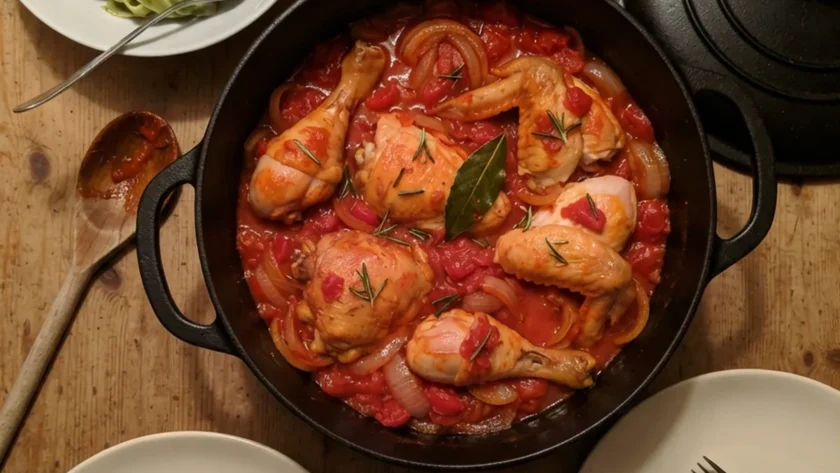

When tomatoes are at their ripest in autumn, Delia Smith’s chicken cacciatore is the one to make, a jointed chicken simmered for 4 in skinned tomatoes, white wine, garlic and rosemary. The sauce bubbles down by half before the chicken goes back in, so it ends up thick enough to cling to every piece.
In How to Cook Book Two (1999) the recipe is chicken cacciatora, her version of the Italian classic, printed next to her step-by-step guide to jointing a chicken. The same recipe appears again in The Delia Collection: Chicken (2003).
She serves it with green tagliatelle, noodles, rice or a simple vegetable. It’s also the base of our marengo with mushrooms and olives, which keeps this method.
Expect tender chicken in a bright, thick tomato sauce that smells of rosemary, with soft, browned slices of onion all through it.
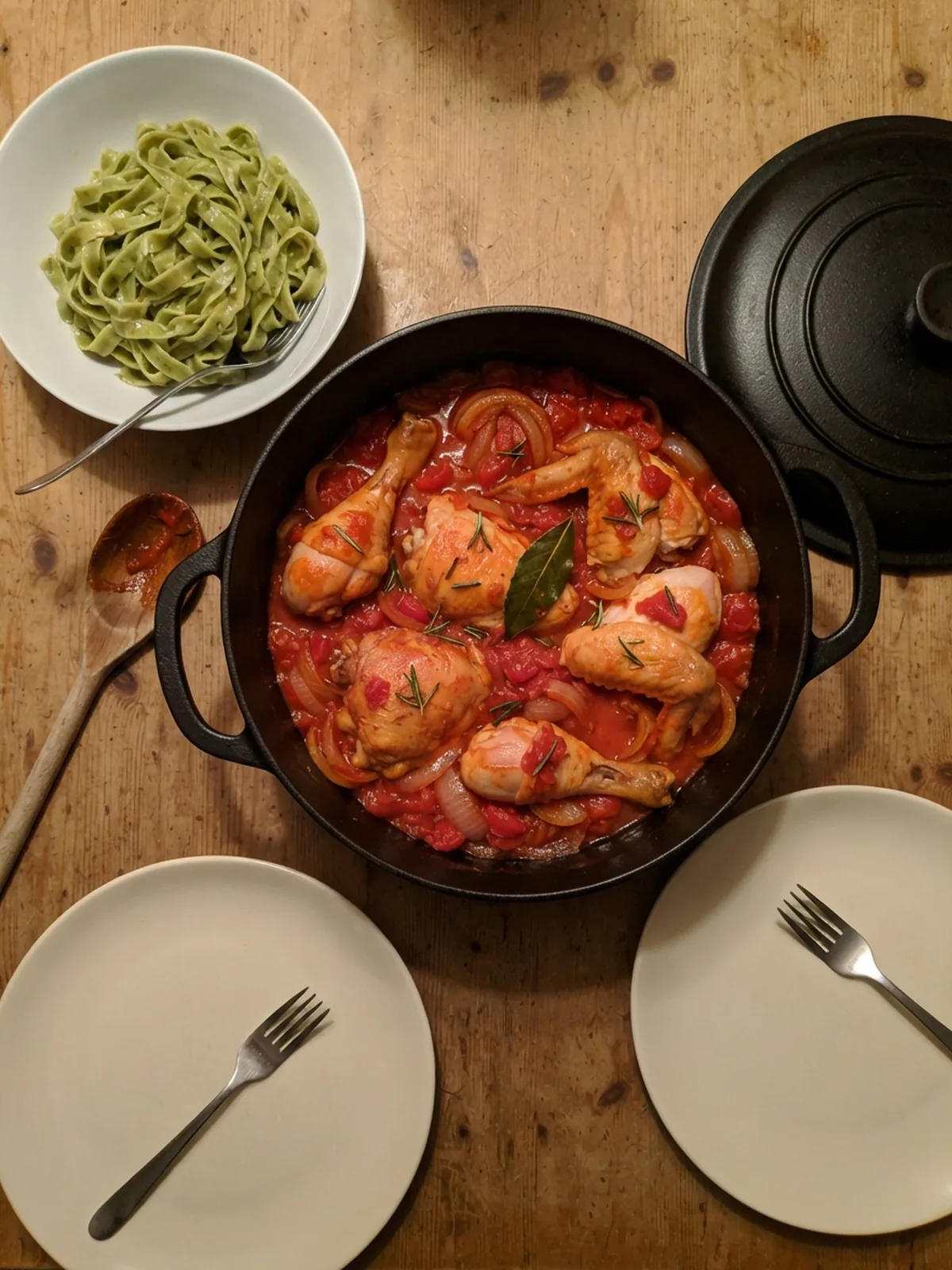
Delia Smith’s Chicken Cacciatora
Course: DinnerCuisine: ItalianDifficulty: Easy4
servings20
minutes1
hour20
minutes635
kcalChicken joints browned hard, then simmered in a reduced tomato and white wine sauce with rosemary, onions and a dash of vinegar.
Ingredients
- For the chicken cacciatora:
1 free-range chicken, about 1.35kg (3lb), jointed into 8 pieces
1 tablespoon olive oil
2 largish onions, thickly sliced
700g (1lb 8oz) ripe red tomatoes
2 large cloves garlic, crushed
1 tablespoon tomato purée
1 tablespoon rosemary leaves, bruised and finely chopped
1 bay leaf
275ml (10fl oz) dry white wine
1 tablespoon white wine vinegar
salt and freshly milled black pepper
Directions
- Brown: Season the chicken. Heat the oil over a high heat in a lidded flameproof casserole of about 3.5 litres (6 pints), and when it’s really hot and shimmering, fry the joints in two batches until golden brown all over. Set each batch aside on a plate.
- Onions: Turn the heat down to medium, add the onions and cook them for 8 to 10 minutes, until softened and nicely browned at the edges.
- Tomatoes: While the onions cook, cover the tomatoes with boiling water and leave them for exactly 1 minute. Drain, slip off the skins and chop the flesh quite small, using a cloth if they’re too hot to hold.
- Sauce: Stir the garlic into the onions for about 1 minute, then add the tomatoes, purée, rosemary, bay leaf, wine and vinegar. Season, bring to the boil and let it bubble uncovered until it has reduced to about half, around 20 minutes.
- Simmer: Return the chicken, stir it in, put the lid on and simmer gently for 40 minutes, until the joints are cooked through.
Notes
- If you'd rather not joint the chicken yourself, a butcher will do it, or buy 8 bone-in pieces, which is my own shortcut. Her own jointing method is in the first FAQ.
- A clear juice from the thickest joint near the bone, with no pink, tells you it's done, my own safety check.
FAQs
How do I cut a chicken into 8 pieces?
Her jointing guide, on the page beside this recipe, starts with a very sharp knife. Cut through the parson’s nose, stand the bird upright and cut straight down the back, then lay it skin side down, open it out like a book and cut through the breastbone.
Turn the two halves over, stretch out each leg and cut along the line between leg and breast. Cut each leg through the thin white line at the joint, then halve each breast, and you have 8 pieces.
How does her quicker version with thighs work?
Her How to Cheat at Cooking (2008) has a shortcut cacciatora for 4 with 8 plump chicken thighs and a 300g jar of tomato frito in place of the ripe tomatoes. The onion, garlic and rosemary are pulsed in a mini-chopper, and the jar is rinsed out with 175ml of white wine and 2 tablespoons of vinegar.
It then barely simmers, covered, for about 40 minutes. She serves that one with egg pasta such as green tagliatelle, or tiny new potatoes and a green salad.
What if it isn’t tomato season?
It still works. She says it’s at its best in autumn, when there’s a glut of full-flavoured tomatoes, but good varieties now make it work in winter too, as long as they’re very red and ripe.
If the shop tomatoes are pale, tinned plum tomatoes are the better choice, about 1½ x 400g tins for the 700g of ripe ones, which is my own swap. Her chicken puttanesca is made with a tin of Italian chopped tomatoes from the start.
Can I use basil instead of rosemary?
You can, but rosemary is the point. Her shortcut version makes the case that tomatoes and rosemary are every bit as good together as the more famous tomato and basil.
If you do use basil, I’d tear it in at the end so it stays green, which is my own tip.
Can I make it a day early?
Yes, it reheats well. I’d let it cool, get it into the fridge within 2 hours, then bring it back to a gentle simmer until piping hot all the way through, my own make-ahead routine.